

Last updated:
October 1, 2026
How an Employer of Record works in Slovenia
Finding the right person is only the start of the process in Slovenia. The harder part is establishing a local legal entity to hire your candidates. This is where an Employer of Record (EOR) can benefit foreign companies. As the legal employer, Rivermate hires local or foreign employees compliantly and manages global payroll and benefits in line with local labor laws.
You do not need to establish a local entity or manage Slovenian laws, which can be complicated to apply in practice. After an initial discovery meeting, we will draft a compliant employment contract, register the employee for social security benefits, and manage ongoing payroll and benefits administration. This will free you to manage the day-to-day operational activities with the employee.
How an Employer of Record, like Rivermate can help with hiring and compliance in Eslovenia
An Employer of Record (EOR) hires on your behalf through its own local entity, so you can employ in Eslovenia without registering a company there. Rivermate handles the employment contract, payroll, employer contributions, statutory benefits and filings, and keeps them correct as the rules change.
Slovenia labor market: At a glance
| The hiring market | |
|---|---|
| Greatest hiring demand: | Osrednjeslovenska Region |
| Hiring timeline for locals: (from initial hiring request to onboarding) | Blue-collar workers: 3 months White-collar workers: 4 months |
| Hiring timelines for foreign nationals: (single-permit application process) | 3 months+ |
| In-demand sectors: | Construction, manufacturing, wholesale and retail |
| Sectors with skills shortages: | Technical and engineering, IT, services Slovenia currently has 100+ professions on its occupation shortage list. Jobs on this list can fast-track visa applications where applicable. |
| The salary market | |
|---|---|
| Employer tax contributions: | Six contributions: 17.1% |
| Monthly minimum wage: | €1,481.88 |
| Average gross earnings: | €2,751.37 (Mid-year 2026) |
| Personal income tax rates: | 16% - 50% |
What will it cost to hire in Slovenia?
Proposing a gross salary for an employee is only the first step in calculating employment costs in Slovenia. In reality, it requires deeper analysis, which requires adding statutory employer contributions, mandatory allowances and the future financial cost of employee rights.
Basic salary in Slovenia
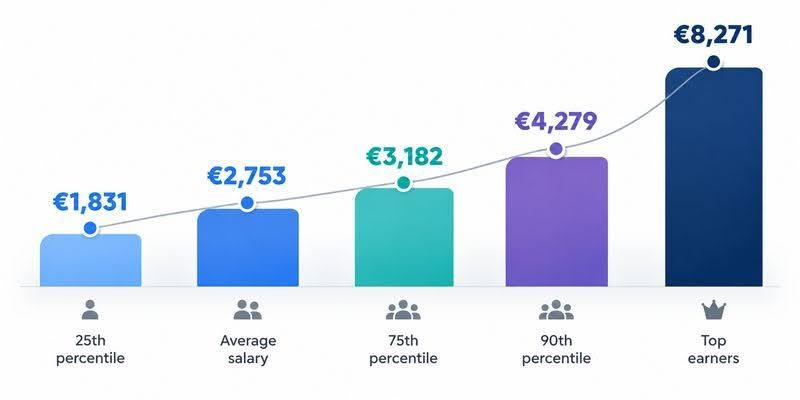
If you’re looking at providing market-related salaries in Slovenia, your analysis should go beyond the minimum wage and national average. The reality is salaries vary between €1,481.88 and €8,271+ depending on the sector you’re hiring in and the skills and experience of your candidate. Wage distribution figures as published by the Republic of Slovenia Statistical Office provide deeper insight into how diverse the salary market in Slovenia really is.
Mandatory holiday pay
Slovenian workers are entitled to two rounds of mandatory holiday pay. The first is an annual leave allowance (regres) to be paid before 1 July, whether or not the employee takes their annual leave. The second is a new mandatory benefit, approved in 2025, the ‘winter bonus’ (zimski regres) and should be paid no later than 18 days after the November pay date. The payment amounts for 2026 are as follows:
- Annual leave allowance: At least the minimum wage of €1,481.88
- Winter bonus: At least half the minimum wage, €740.94
Both allowances are tax-free and exempt from social security contributions up to the average monthly salary in Slovenia.
Employer statutory obligations
According to SPOT (State Portal for Business Entities), employers pay contributions as a withholding tax at payroll. The Financial Administration of the Republic of Slovenia monitors contributions. Employer contributions are listed as follows:
| Contribution | Percentage |
|---|---|
| Pension and disability insurance | 8.85% |
| Compulsory health insurance | 6.56% |
| Long-term care health insurance | 1% |
| Parental protection insurance | 0.10% |
| Unemployment insurance | 0.06% |
| Injury-at-work and occupational disease insurance | 0.53% |
The Health Insurance Institute in Slovenia collects health insurance contributions and uses them to fund the health care system. It also manages benefits and rights of citizens to ensure adequate healthcare is provided.
Guía de Employer of Record para Eslovenia
Su guía paso a paso para la contratación, cumplimiento y gestión de nóminas en Eslovenia con soluciones de EOR.
Statutory employee rights
The Slovenian Employment Relationships Act governs employee rights and guarantees statutory minimum standards for compensation, working hours and leave. Every legal employer must provide employees with these minimum rights, and, either through a collective agreement or an employment contract, can provide greater benefits.
| Statutory benefits | Description |
|---|---|
| Working hours | Maximum 40 hours per week, and not less than 36 hours a week for full-time workers. |
| Public holidays | A mixture of national holidays and other work-free holidays. |
| Some holidays are not work-free and are purely commemorative. | |
| Mandatory rest period | Mandatory rest between two working periods, i.e 12 hours in 24 hours. |
| Overtime | Limited to a maximum of 8 hours a week, 20 hours per month or 170 hours per year. Overtime rates are determined by collective agreements as well as standard labor laws. |
| Annual leave | Article 159 of the ZDR-1: 20 working days for full-time workers on a 5-day work week schedule. A minimum of two weeks should be planned for every calendar year. |
| Sick leave | There is no maximum number of sick leave days that can be taken per year. A doctor’s note must support sick leave. The employer pays for the first 30 days of absence, after which it is funded by the social security system. Employees can lose their compensation benefits if they fail to comply with the employment practices governing sick leave. |
| Maternity leave | Article 19 - 24 of the ZSDP-1: Mothers are entitled to 105 consecutive days' leave. It must begin 28 days before the expected date of delivery. Mothers must take at least 15 days of maternity leave. |
| Other statutory payments | An employer must reimburse lunch costs during working hours and travel costs arising from certain work and tasks when traveling to work, e.g., traveling from home to a work conference in another city. |
| Severance pay | Employees are entitled to severance pay when conditions are met as regulated by the ZDR-1. The base calculation is on the average gross monthly salary in the 3 months preceding the termination. 1 - 10 years of service: ⅕ of the base for each year. 10-20 years of service: ¼ of the base for each year. More than 20 years: ⅓ of the base for each year. Severance is capped at 10 times the base salary as per Article 108 of the ZDR-1. |
Calculate employment costs
Calcular costos laborales
Desglose de costos laborales
Seleccione un país e introduzca un salario para ver el desglose del costo de empleo.
What hiring in Slovenia really looks like
| Market condition | Current reality |
|---|---|
| Hiring momentum | 🔴 Tight labour market |
| Talent availability | 🔴 Restrictive due to low unemployment rate |
| Specialist talent | 🔴 Competitive |
| Salary pressure | 🔴 High |
| Candidate expectations | 🔴 High |
The Slovenian labor market is tight
Currently, Slovenia has the third lowest unemployment rate in the world, around 4.4%. This makes it a tough market to find readily available workers, especially blue-collar workers. The practical effect is longer hiring timelines. It is common practice for employees to give 30 or 60 days' notice after at least two rounds of interviews. This means hiring can take between 3 and 4 months. To alleviate the labor pressure, foreign nationals are being recruited, mainly from the former Yugoslav republics, but Asian workers are also in demand.
Candidates focus on net salary
Slovenian candidates are primarily concerned with their net salary, or ‘take-home’ pay, and tend to benchmark offers against colleagues or acquaintances in similar jobs or fields. This can make it difficult to use national averages or even industry norms to benchmark salaries because it is as much about perception as it is about real numbers.
Salaries are rising rapidly year to year
Average gross earnings rose 7.6% year-on-year in mid-2026. Substantial increases in minimum wage levels and reforms to public sector wages have translated into higher employment costs in Slovenia. Minimum wage levels have risen substantially, reaching €1,481.88 in 2026, compared with €940.58 in 2020, an increase of around 58%.
Retention is a real employment challenge
Currently, the average expected length of employment of a blue-collar worker is 6 months in Slovenia. In practice, this creates an ongoing challenge in retaining new employees and doubles the annual resources and money an employer needs for recruitment.
Employer sponsorship: work permits and visas
Slovenia has several prescribed pathways for entering the labor market. Here we discuss those pathways and what employers can expect when relocating an employee to Slovenia for work.
Entry pathways into Slovenia for foreign nationals
- Non-EU/EEA nationals: Slovenia single work and residence permit. Valid for the duration of the contract but no more than two years. An extension may be granted if the legal conditions are met and the employer applies before the existing visa expires.
- EU Blue Card: For highly skilled professionals from non-EU/EEA countries.
- EU/EEA/Swiss nationals: No permit required; they can work and live in any EU/EEA country. Stays longer than three months require employees to obtain a Residence Registration Certificate.
Employer sponsorship, a valid employment contract and the single work and residence permit are required for an employee to work in Slovenia. International employees cannot simply enter Slovenia with an employment contract.
Employers must pass a labor market test proving they could not find suitable local skills before employing a foreign national. Exceptions may apply for occupations on the occupation-shortage list, in which case the Employment Service of Slovenia (ZRSZ) may fast-track consent.
An EOR provider in Slovenia, like Rivermate, can sponsor certain eligible occupations as the legal employer. However, immigration decisions and processing timelines depend on Slovenian authorities.
How an Employer of Record, like Rivermate can help with work permits in Eslovenia
La gestión de permisos de trabajo puede ser compleja y con plazos ajustados. Rivermate coordina todo el proceso de principio a fin: determinar la categoría de visa adecuada, preparar la documentación del empleador y del empleado, gestionar las relaciones con las autoridades locales y garantizar el pleno cumplimiento de las normas específicas de cada país. Nuestros expertos locales aceleran los plazos, reducen al mínimo las denegaciones y le mantienen informado sobre cada hito para que su contratación pueda comenzar a tiempo, de forma legal y con confianza.
Compliance risks that employers must know about
Partnering with an EOR provider for your hiring needs in Slovenia gives you peace of mind that your compliance will be handled by local experts. However, you will still need to make key decisions that affect the employment relationship. This requires an understanding of some basic employment regulations.
Pre-employment medical checkup
The employee must undergo a preventive medical examination before employment. This medical examination can only be carried out by an authorized healthcare practitioner. In Slovenia, it can sometimes take up to 14 days to get an appointment, so factor this into hiring timelines.
Employment agreements
Defining contractual employment rights in Slovenia relies heavily on three pillars:
- The Employment Relations Act (ZDR-1)
- Sectoral Collective Agreements
- Company policies
The ZDR-1 sets the minimum statutory requirements for workers, while the sectoral agreements prescribe additional benefits for certain industries. Both frameworks take precedence over your internal policies. An employer may offer more than the statutory requirements, but never less.
Indefinite-term contracts are the most common type of contract in Slovenia, and fixed-term contracts may be used only for specific reasons. Their maximum duration is two years. Only under exceptional circumstances can the duration of a fixed-term contract be extended past two years in total.
Sectoral collective agreements
Employers must establish whether a sectoral collective agreement applies to their industry or sector. These agreements supersede the basic conditions of employment and can affect minimum wage levels, working hours, allowances, leave and other employment conditions.
Employment termination
In Slovenia, terminations can be difficult. Workers have strong protections against unlawful dismissal, and employers must make severance payments in certain circumstances. Employees have 30 days to seek a judicial determination of whether a termination was unlawful. In certain situations, the employer and employee can agree to resolve the dispute through mediation and, if mediation is unsuccessful, take the case to the Labor Court.
Why use EOR services in Slovenia?
Slovenia has a deep talent pool and a well-established employment framework, giving international companies stability and strong hiring opportunities. But in practice, setting up a local entity is harder than most employers think, and understanding Slovenian employment laws can be time-consuming. It can also be an expensive exercise if you unknowingly make a payroll or compliance error.
An Employer of Record provider, like Rivermate, helps you to mitigate these risks by taking on the role of legal employer. The responsibility for managing compliance and complex labor regulations comes to us, so your attention can shift to the daily management of the employee’s work activities and performance. We like to think of it as a partnership because that’s how we treat it from day one.
Ready to hire in Slovenia?
If you’re ready to take the next step, talk to our local hiring expert about your hiring needs.
Contrata a los mejores talentos en Eslovenia a través de nuestro servicio de Employer of Record
Reserva una llamada con nuestros EOR expertos para obtener más información sobre cómo podemos ayudarte en Eslovenia.







Reserve una llamada con nuestros expertos de EOR para saber más sobre cómo podemos ayudarle en Eslovenia.
Con la confianza de más de 1.300 empresas en todo el mundo.


Preguntas frecuentes sobre EOR en Eslovenia
Sources:
Employment Relations Act ZDR-1
Slovenia - Individual - Taxes on personal income
Right to an annual leave allowance
Employment contract | SPOT
Social security and insurance | SPOT
Home - Health Insurance Institute of Slovenia
Slovenia – Introducing New Contributions under the Long-Term Care Act
Slovenia - Individual - Other taxes
Earnings of persons in paid employment by legal persons, June 2026
Payment | SPOT
https://www.gov.si/novice/2025-11-24-podrobneje-o-pravici-do-zimskega-regresa/
Escrito por

Nika Khurtsidze
Nika, a Business Development Specialist at Rivermate, a leading Employer of Record company, has been helping businesses navigate global employment complexities for a year. He partners with companies expanding internationally, guiding them toward EOR solutions that streamline hiring and reduce operational costs. His expertise lies in business development and global workforce management, areas he’s developed since joining Rivermate. Surrounded by seasoned professionals, he sharpens his expertise daily, bringing fresh perspectives and a commitment to delivering value to clients and companies. He appreciates meaningful connections and has built relationships with professionals in the Global Employment and HR space. He aims to expand his network to help more companies unlock the potential of global expansion through smarter, more efficient employment solutions.
Ver perfilRevisado por

Sebastien Wakim
Sébastien Wakim es CEO de Rivermate y ha liderado el grupo Hightekers desde 2024. Como uno de los primeros empleados de Uber, lanzó y escaló las operaciones de la empresa en varios mercados de MENA antes de ocupar cargos de liderazgo senior en OLX Group. Posteriormente, cofundó Wisewell, una empresa de tecnología del agua activa en Estados Unidos y la región del CCG. Tiene un MBA de Columbia Business School y una maestría en ingeniería de UC Berkeley.
Ver perfil