



Best EOR Services in Hong Kong: Top 10 Providers for 2026
Hong Kong is often treated as an easy first step into Asia, but hiring there tells a different story. The rules around employment are detailed, and they don’t leave much room for error. Employer responsibilities don’t end at payroll, and changes in recent years have made exits more complex than many companies expect. Without people on the ground who understand how things work in practice, it’s easy to underestimate the time and risk involved.
What keeps companies coming back is the talent. Hong Kong has long been a place where experienced professionals build careers, particularly in finance, legal work, and regional operations. There’s also a steady flow of graduates trained in newer fields, and English is simply how business gets done. For companies coordinating teams across multiple countries, that matters more than any headline incentive.
If you’re looking to break into the Hong Kong market, setting up a local entity can work, but it’s rarely the fastest option. There’s paperwork, maintenance, and compliance that doesn’t disappear once the company is registered. Many teams choose an Employer of Record instead, not because it’s trendy, but because it removes friction. The EOR handles local employment obligations, while the company focuses on the actual work. For most businesses, that trade-off is what makes hiring in Hong Kong realistic rather than theoretical.
Top 10 EOR Services in Hong Kong
| Provider |
Starting Price |
Onboarding Speed |
Best For |
| Rivermate |
€299/employee/month |
Fast (1–3 days) |
Startups needing hands-on support |
| Remote |
US$599/employee/month |
Fast (2–5 days) |
Tech companies scaling globally |
| Woodburn Global |
Custom pricing |
Varies (case-by-case) |
Companies needing bespoke HK expertise |
| Multiplier |
~US$400/employee/month |
Moderate (3–7 days) |
SMEs needing cost-effective EOR |
| AYP Group |
Custom pricing |
Moderate (5–10 days) |
Companies expanding across Asia |
| Oyster HR |
US$699/employee/month |
Moderate (5–10 days) |
Corporate teams hiring globally |
| Globalization Partners |
Custom pricing |
Fast (2–5 days) |
Enterprises requiring robust compliance |
| Pebl (formerly Velocity Global) |
Custom pricing |
Moderate (5–10 days) |
Mid-to-large companies with distributed teams |
| Skuad |
US$199/employee/month |
Fast (2–5 days) |
Startups seeking budget-friendly EOR |
| Papaya Global |
US$599/employee/month |
Moderate (5–10 days) |
Tech companies with internal HR systems |
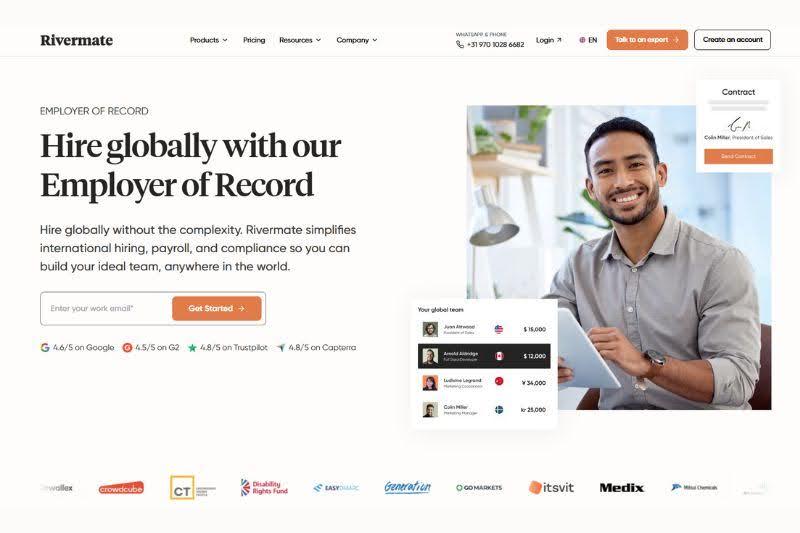
1. Rivermate — Best overall EOR in Hong Kong

Rivermate positions itself as a practical, full-service Employer of Record for companies that need more than basic payroll support. While the platform operates globally, it is especially strong in markets where employment compliance is strict and mistakes can be costly—Hong Kong being a clear example. For startups and scaling teams without in-house legal or HR expertise, Rivermate offers a balance of automation and hands-on guidance that goes beyond standard EOR tooling.
Hong Kong’s employment framework leaves little room for error, and Rivermate’s approach reflects that reality. Instead of relying on generic global processes, the platform emphasizes country-specific accuracy and operational support.
Why companies choose Rivermate for Hong Kong EOR
1. Deep understanding of Hong Kong employment law
Rivermate is well-versed in the nuances of Hong Kong’s Employment Ordinance. Employment contracts generated through the platform include all required statutory elements, such as working hours, rest days, wage payment terms, and termination conditions. This is particularly relevant given recent regulatory changes, including the updated Statutory Minimum Wage and the introduction of the new “468 rule” for continuous employment. Rivermate actively updates its templates and workflows to reflect these changes.
2. MPF administration handled with precision
MPF compliance is one of the highest-risk areas for employers in Hong Kong. Rivermate reduces this risk by automating MPF contribution calculations in line with Hong Kong’s tiered contribution structure, regardless of pay frequency. With the abolition of MPF offsetting in 2025, accurate tracking and reporting have become even more critical—functions that Rivermate manages automatically.
3. Accurate statutory leave management
Hong Kong’s statutory leave framework is detailed and easy to misinterpret. Rivermate manages annual leave accrual schedules, sick leave accumulation rules, and entitlement caps, ensuring accuracy from the first year of employment onward. The platform tracks entitlements in real time and flags upcoming obligations, reducing administrative burden and compliance risk.
4. Employment contracts built for local enforcement
Each Rivermate contract is tailored specifically to Hong Kong requirements. Key areas such as probation periods, notice requirements, wage payment terms, and statutory obligations are clearly defined. This helps prevent misclassification disputes and ensures employees have clear, enforceable documentation outlining their rights.
5. Embedded local HR guidance
Beyond payroll and contracts, Rivermate provides practical guidance on complex HR scenarios. This includes handling statutory holidays that fall on rest days and administering Hong Kong’s 14-week maternity leave entitlement for eligible continuous employees. This level of local insight is particularly valuable for foreign employers.
- G2 rating: 4.9/5
- Free trial: No
- Country coverage: 180+ countries
Pros
Rivermate’s strongest advantage is its compliance-first approach. Employment contracts and payroll processes are continuously updated, and employers are proactively informed of regulatory changes. Users frequently cite confidence in MPF handling and statutory leave administration. The platform also performs well on speed—onboarding can often be completed within a few days for standard roles, which is a significant advantage in Hong Kong’s competitive hiring environment.
Offboarding is handled carefully as well, including correct payout of accrued but unused statutory leave, which is mandatory under local employment law.
Cons
Rivermate may be less suitable for companies with highly complex HR technology stacks, as enterprise-level integrations and API availability are more limited than some larger competitors. The platform also does not manage IT equipment or access provisioning, requiring separate internal systems. For very large-scale operations, some alternatives may offer more advanced automation at scale.
2. Remote — Best for tech companies scaling globally
Remote positions itself as a tech-first Employer of Record (EOR) platform built around automation, transparency, and self-serve workflows. It is particularly well suited for technology companies expanding internationally, especially those managing distributed engineering teams and modern software stacks.
Why use Remote for EOR
- Automated Hong Kong payroll with accurate Salaries Tax calculations and progressive withholding
- MPF compliance built in, aligned with the May 2025 HK$17,200 monthly threshold
- Fast contract generation, compliant with Hong Kong’s Employment Ordinance
- Tech-first, self-serve platform designed for speed and scale
- Supports both Hong Kong employees and contractors, ideal for blended workforce models
Key details
- G2 Rating: 4.5 / 5
- Price: US$599 per employee per month
- Free Trial: Yes (limited features)
- Country Coverage: 70+ countries
Pros of Remote
- Strong alignment with tech and software companies
- Intuitive dashboard for leave, approvals, and compliance documents
- Competitive onboarding speed (2–5 business days on average)
- Detailed payroll and cost reporting to support forecasting
- Well suited for asynchronous, distributed teams
Cons of Remote
- Higher price point (US$599 per employee/month) compared to some mid-market EORs
- Interface can feel complex for Hong Kong-specific edge cases
- Limited enterprise integrations, especially with legacy ERP systems
3. Woodburn Global — Best for deep Hong Kong expertise
Woodburn Global stands out for its highly localized Hong Kong and China expertise. Rather than offering a standardized, platform-led EOR experience, Woodburn delivers hands-on, bespoke compliance and HR guidance, making it well suited for companies with complex employment needs in Hong Kong.
Why use Woodburn Global for EOR
- Strong local Hong Kong presence with on-the-ground employment law, accounting, and compliance specialists
- Direct guidance on complex regulatory requirements
- Strategic HR compliance support beyond payroll administration
- Expert handling of terminations, notice periods, and severance
- Integrated accounting, payroll, and tax expertise for cohesive financial reporting
Key details
- G2 Rating: Not listed
- Price: Custom pricing
- Free Trial: No
- Country Coverage: Primarily Hong Kong and China
Pros of Woodburn Global
- Exceptional depth in Hong Kong employment law and compliance
- Ideal for companies making significant or long-term investments in Hong Kong
- Strong local professional network (banking, corporate governance, advisors)
- Excellent support for complex employment structures (executives, founders, regional management)
- Valuable guidance for companies planning to transition from EOR to a local entity
Cons of Woodburn Global
- Limited geographic coverage, primarily Hong Kong and China
- No self-serve platform, with more manual, relationship-driven workflows
- Custom pricing only, reducing transparency and extending sales cycles
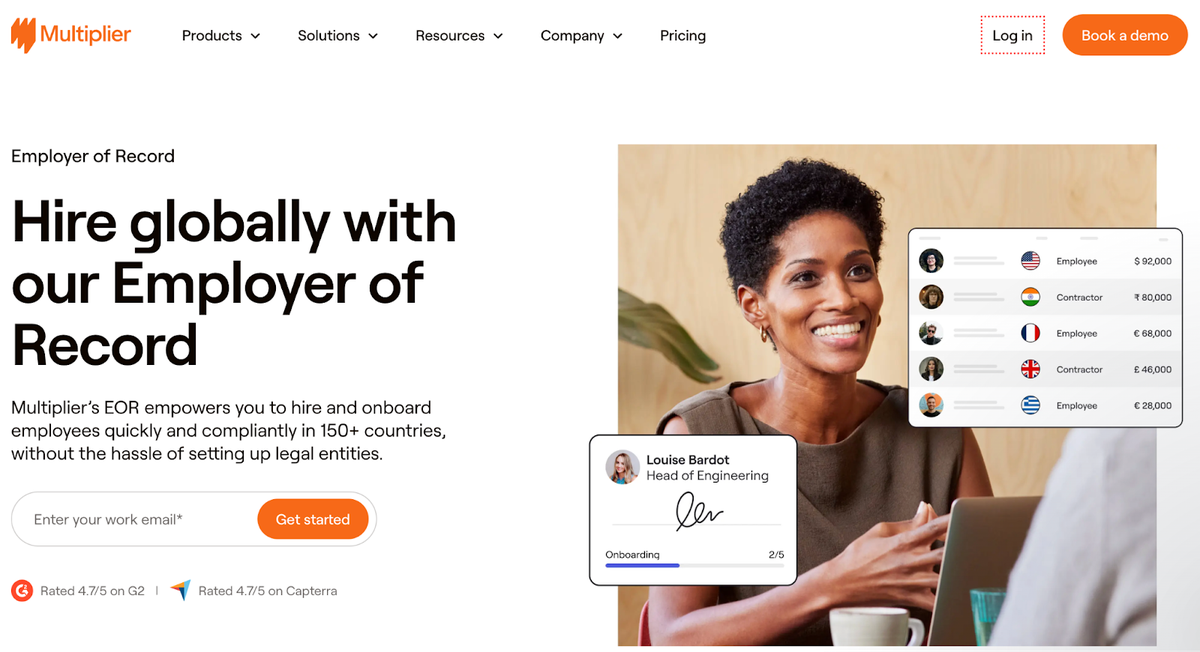
4. Multiplier — Best for SMEs needing cost-effective EOR

Multiplier blends automation-driven compliance with competitive mid-market pricing, making it a strong choice for small and medium enterprises (SMEs) that need reliable EOR support without enterprise-level costs. It is particularly well-suited for companies in the 10–50 employee range, where cost control and speed are key.
Why use Multiplier for EOR
- Automated compliance monitoring for Hong Kong labor law updates
- Accurate MPF automation
- Fast, SME-friendly onboarding (typically 3–7 days)
- Guided workflows, templates, and checklists for founders and lean HR teams
Key details
- G2 Rating: 4.6 / 5
- Price: ~US$400 per employee per month
- Free Trial: Yes
- Country Coverage: 150+ countries
Pros of Multiplier
- Lower cost than premium EOR providers without major compliance trade-offs
- Free trial available, reducing buying risk
- Multilingual support, including Cantonese for Hong Kong teams
- Efficient batch hiring for multi-role recruitment
- Well-suited for fast-growing SMEs with limited HR resources
Cons of Multiplier
- Country coverage (150+) slightly narrower than some top-tier competitors
- Some advanced features (custom reporting, APIs) require paid add-ons
- Pricing for premium features may not be fully transparent upfront
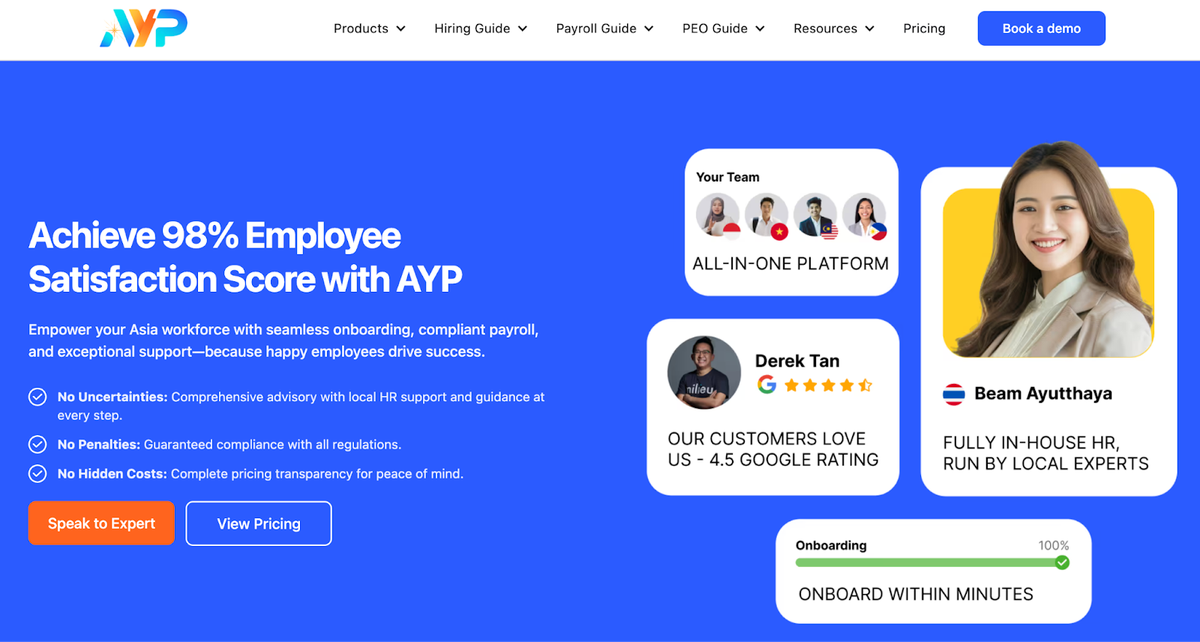
5. AYP Group — Best for Asia-Pacific expansion

AYP Group focuses exclusively on Asia-Pacific (APAC) employment solutions, making it an excellent choice for companies planning regional expansion beyond Hong Kong. Its combination of local Hong Kong expertise and multi-country APAC coverage positions AYP as a strong strategic partner for building a cohesive regional workforce.
Why use AYP Group for EOR
- APAC-wide regional expertise with strong local presence
- Enables multi-country hiring through a single provider
- Deep Hong Kong compliance expertise, aligned with regional operations
- Strong guidance on MPF and statutory compliance
- Consistent regional onboarding and benefits frameworks
Key details
- G2 Rating: 4.6 / 5
- Price: Custom pricing
- Free Trial: No
- Country Coverage: APAC-focused
Pros of AYP Group
- Strong fit for hub-and-spoke APAC strategies with Hong Kong as a regional HQ
- Deep, on-the-ground local knowledge across APAC markets
- Ensures consistency across countries while respecting local regulations
- Access to regional professional networks beyond standard EOR services
- Effective coordination of payroll, compliance, and hiring across markets
Cons of AYP Group
- Longer evaluation and sales cycles due to tailored scoping
- APAC-focused coverage, limiting usefulness for global (non-APAC) expansion
- Platform automation is less advanced than tech-first global competitors
6. Oyster HR — Best for simplicity and global scale
Oyster HR is designed for companies that prioritize ease of use, transparency, and global reach over deep country-by-country customization. Its clean interface and standardized workflows make it a strong fit for remote-first teams hiring across many markets simultaneously.
Why use Oyster HR for EOR
- Simplified regulatory compliance through clear, guided workflows
- Transparent payroll calculations
- Unified global hiring interface for multi-country onboarding
- Consistent processes that adapt to local requirements
- Suitable for standard employment scenarios
Key details
- G2 Rating: 4.5 / 5
- Price: US$699 per employee per month
- Free Trial: Yes
- Country Coverage: 130+ countries
Pros of Oyster HR
- Very user-friendly platform with low learning curve
- Ideal for founders and small HR teams without legal expertise
- Clear, visually intuitive dashboard
- Transparent pricing structure with no hidden fees
Cons of Oyster HR
- Complex scenarios may require external legal or advisory support
- Country coverage (130+) is narrower than top-tier global providers
- Less suitable for highly customized or regulated environments
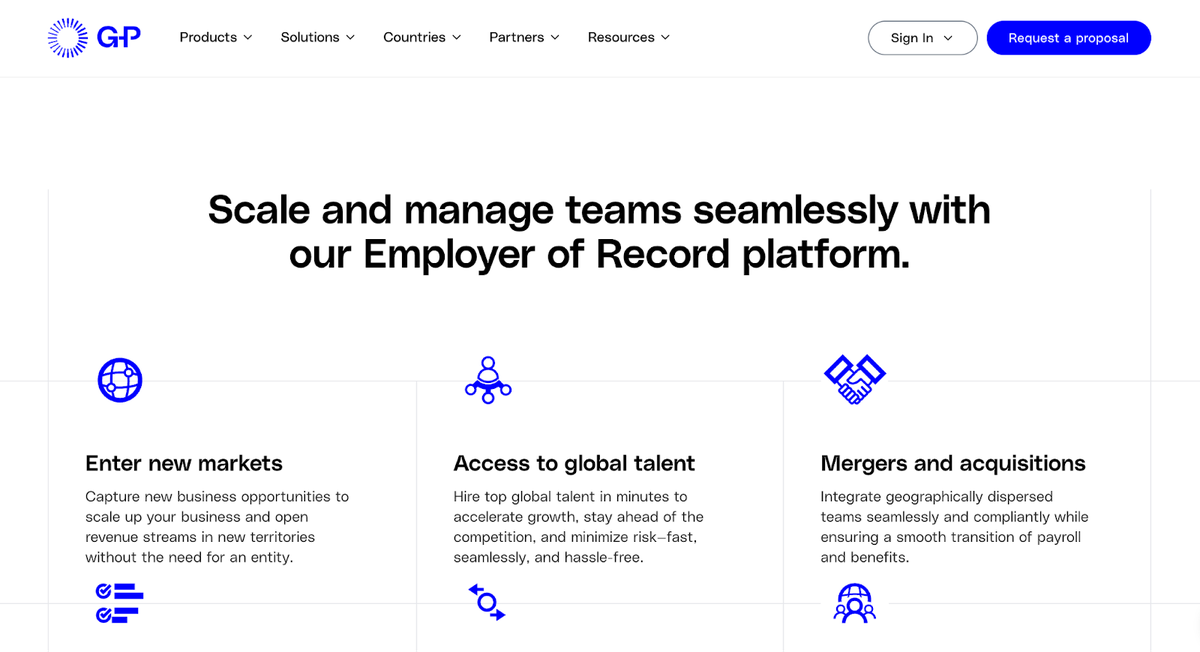
7. Globalization Partners — Best for enterprise-scale compliance

Globalization Partners (G-P) is positioned squarely at the enterprise end of the EOR market, serving multinational organizations that require maximum compliance assurance, legal defensibility, and reporting rigor.
Why use Globalization Partners for EOR
- Direct legal entity ownership in countries of operation
- Avoids reliance on third-party partner networks
- Strong Hong Kong employment law expertise
- Proactive compliance updates to reduce regulatory risk
- Comprehensive tax and regulatory reporting
Key details
- G2 Rating: 4.5 / 5
- Price: Custom pricing
- Free Trial: No
- Country Coverage: 180+ countries
Pros of Globalization Partners
- Ideal for regulated or audit-heavy industries
- Direct control over in-country employment entities
- Extensive reporting and documentation
- Very broad global coverage (180+ countries)
- Enables long-term global expansion without switching providers
Cons of Globalization Partners
- Premium enterprise pricing
- Longer, more structured onboarding timelines
- Less suitable for companies needing rapid market entry
Pebl targets mid-to-large organizations managing complex, globally distributed workforces. The platform emphasizes compliance rigor, legal framework strength, and around-the-clock regional support, well-suited for companies operating across multiple regions and workforce types.
Why use Pebl for EOR
- Strong Hong Kong compliance processes
- Processes aligned with the 2025 regulatory environment
- Supports both permanent employees and contractors
- 24/7 regional support with access to local expertise
- Very broad global coverage (185+ countries) for large-scale expansion
Key details
- G2 Rating: 4.5 / 5
- Price: Custom pricing
- Free Trial: No
- Country Coverage: 185+ countries
Pros of Pebl
- Excellent fit for mixed workforce models (employees + contractors)
- True 24/7 support with regional teams, not centralized queues
- Strong for companies scaling across multiple regions simultaneously
- Compliance-first approach reduces regulatory risk in complex operations
Cons of Pebl
- Enterprise service model can mean higher costs for mid-market firms
- Process-heavy approach may feel slower than speed-focused platforms
- Less suitable for companies prioritizing ultra-fast onboarding
9. Skuad — Best for budget-conscious startups
Skuad is designed for early-stage and budget-conscious startups that need compliant global hiring without premium pricing. With one of the lowest EOR price points on the market, Skuad enables fast entry into Hong Kong while maintaining core statutory compliance.
Why use Skuad for EOR
- Very affordable pricing at US$199 per employee/month
- Covers essential Hong Kong compliance
- Fast onboarding (typically 2–5 days)
- Core HR automation
Key details
- G2 Rating: 4.7 / 5
- Price: US$199 per employee per month
- Free Trial: No
- Country Coverage: 160+ countries
Pros of Skuad
- Among the most cost-effective EOR providers
- Significant savings vs. premium platforms (especially at small headcount)
- Handles multi-currency payroll and payments
- Ideal for startups with lean HR teams and tight burn control
Cons of Skuad
- Fewer advanced features for complex compensation structures
- Platform automation is less sophisticated than mid-market competitors
- Some edge-case compliance scenarios may require manual support
10. Papaya Global — Best for tech companies with strong internal systems

Papaya Global is built for companies with mature internal HR infrastructures that want to outsource payroll execution without replacing their existing HR stack. It functions best as a powerful payroll engine, integrating deeply with enterprise HR systems rather than offering an all-in-one EOR experience.
Why use Papaya Global for EOR
- Centralized payroll processing engine with high calculation accuracy
- Proactive compliance monitoring
- Deep integrations with enterprise HRIS
- Enables companies to retain existing HR workflows
- 24/7 global support for multi-time-zone payroll operations
Key details
- G2 Rating: 4.5 / 5
- Price: US$599 per employee per month
- Free Trial: No
- Country Coverage: 160+ countries
Pros of Papaya Global
- Excellent fit for enterprises with established HR tech stacks
- Reduces internal HR workload through payroll automation
- Strong handling of complex, multi-jurisdiction payroll
- Reliable 24/7 support with local legal expertise
Cons of Papaya Global
- Not ideal for startups or budget-conscious teams
- Requires maintaining a separate HR platform
- More IT involvement compared to simpler, all-in-one platforms
How to choose the right EOR in Hong Kong
When choosing an EOR in Hong Kong, it helps to look beyond features and focus on where problems usually appear. Early hires often surface issues around contract accuracy, notice periods, MPF setup, and payroll timing. In these moments, clear communication and fast responses matter more than polished tooling. If you are hiring under time pressure, even small delays or vague answers can cost you strong candidates.
As your team grows, the risk profile changes. You need confidence that employment terms remain consistent, changes are properly documented, and local practices are followed when situations become more complex, such as promotions, terminations, or role changes. Some companies benefit from hands-on local guidance, while others prefer predictable, standardized processes they can manage internally. The right EOR is the one that removes friction at the points where your business is most likely to feel it, both today and as you scale.
Hong Kong compliance considerations
Hiring in Hong Kong through an EOR still requires a clear understanding of how local employment rules work, even if the operational work is outsourced. Employers need to be confident that payroll is run on time, employee contracts follow the Employment Ordinance, MPF obligations are handled correctly, and payroll records are properly maintained. These fundamentals are closely regulated and mistakes can carry real consequences.
Employment protections have also evolved, particularly around minimum wage, continuous employment and mandatory provident fund requirements. The updated 468 rule means more workers qualify for statutory benefits, including paid public holidays, annual leave that increases with service, sick leave, and family-related leave. If employee status is not assessed accurately, benefits can be missed and compliance issues can arise.
Leave management is another area that often causes problems if not monitored carefully. Statutory annual leave cannot be forfeited and must be paid out when an employee leaves, while holiday and leave pay follow specific legal rules. Employers should also pay attention to how employee data is stored and accessed, especially when working with third parties. A reliable EOR should have clear processes in place to manage leave, payroll, and data securely and consistently.
Conclusion
Expanding into Hong Kong is not especially difficult, but it is unforgiving if you get employment basics wrong. An Employer of Record sits in the middle of that risk. The right one keeps things moving. The wrong one creates friction that shows up months later.
What matters most is not how many features a provider lists, but how they operate in practice. How clearly they explain local rules. How they react when something changes. How they handle terminations, salary adjustments, or employee questions without turning them into drawn-out processes.
Hong Kong’s talent market is deep and competitive, and expectations from employees are high. Delays, unclear communication, or compliance mistakes quickly damage trust. That is why it pays to choose a provider that is strong on local execution, not just setup.
Before committing, compare providers carefully and speak with companies already employing in Hong Kong. A few extra hours spent evaluating now can prevent operational problems later and give your team a much smoother path as you grow.
For a practical overview of employment rules, compliance obligations, and how EOR arrangements work in practice, see Employer of Record in Hong Kong: A Quick Glance. It outlines the essentials companies should understand before hiring locally.
FAQs
What does an EOR do in Hong Kong?
They employ the person locally, so you do not have to. That means contracts, payroll, tax filings, MPF, and statutory leave are handled under Hong Kong law. You still run the role. The employee works for you day to day, not the EOR.
How fast can I hire through an EOR?
If the paperwork is ready, it can be done in a few days. That is the main advantage. Setting up your own entity takes much longer, so an EOR is usually the fastest way to get someone on payroll.
Do I still manage the employee’s work?
Yes. You set priorities, approve time off, review performance, and decide what the role looks like. The EOR does not manage the employee or get involved in daily work.
How much does an EOR cost in Hong Kong?
It is usually a monthly fee per employee. Pricing depends on the provider and what is included. Some charge extra for setup, changes to contracts, or offboarding, so it is worth asking about those early.
What employer obligations apply in Hong Kong?
Employers are responsible for MPF, tax withholding, minimum wage, and statutory leave. The rules are well defined but detailed. An EOR takes care of this in practice, but you should still understand what applies to your team.
Is setting up a local entity better than using an EOR in Hong Kong?
A local entity can make sense for long-term operations, but it requires ongoing administration, audits, and local entity ownership obligations. Many businesses expanding into Hong Kong choose an EOR first to achieve full regulatory compliance with significantly less operational overhead.
How does an EOR support Hong Kong expansion for global companies?
An Employer of Record simplifies Hong Kong expansion by acting as the legal employer on your behalf. This allows global companies to hire local talent quickly without setting up a local entity, while ensuring contracts, payroll, and benefits follow local compliance requirements. Many startups choose an EOR to validate market demand before committing capital to permanent Hong Kong operations.
What should companies look for when choosing an EOR?
Beyond pricing transparency, companies should evaluate service quality, responsiveness, and whether the provider offers personalized support. Strong execution matters more than features, especially when handling terminations, payroll corrections, or employee disputes.