



Rivermate logo

Taxation and Compliance

9 mins read

Why 1099 Write-Offs Affect Hiring of Independent Contractors

Published on:

Mar 2, 2026

Updated on:

Mar 2, 2026

Rivermate | Why 1099 Write-Offs Affect Hiring of Independent Contractors

Planning your hiring strategy has probably led you down the road of considering independent contractors at some point. Maybe the ideas went like this: I won’t have to pay expensive benefits (like health insurance premiums and car expenses). They will take care of their own tax deductions. I can terminate the contract when I no longer need them. I can get access to a great talent pool with the expertise I need. The benefits seemed obvious.

The truth is that’s only half the story. You may not need to worry about their taxable income and business expenses, but they do affect your hiring. If you’re interested in understanding how 1099 write-offs affect your hiring strategy and total cost of engagement, this guide will help you make better decisions by providing the bigger picture.

Key Takeaways

  • 1099 write-offs are legitimate business expense deductions that self-employed individuals claim to reduce their business income.
  • The deductions affect how you hire because they influence worker classifications, contractor pricing, and compliance risk.

What are 1099 write-offs?

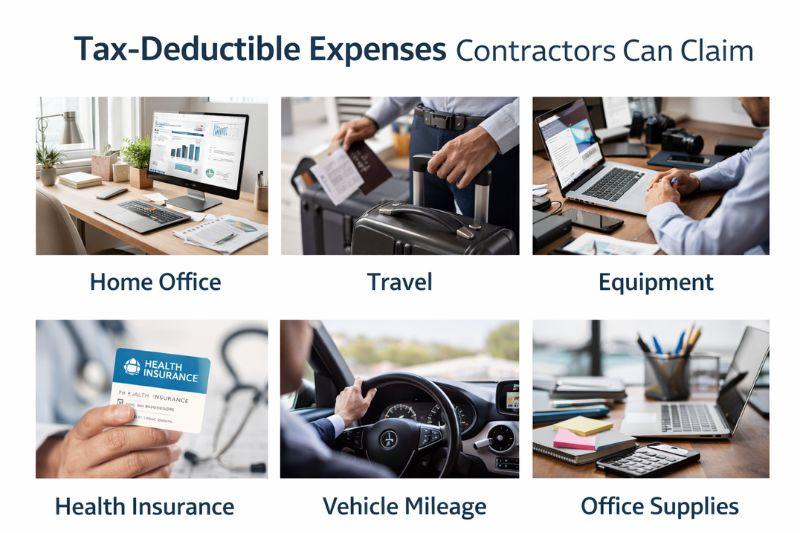
Infographic showing common 1099 write offs for independent contractors expenses

A 1099 write-off refers to business expenses that self-employed individuals (contractors, freelancers, and sole traders) deduct from qualified business income. These individuals provide services to your company, but they are not a w 2 employee (a person on your payroll). Instead, they receive Form 1099-NEC from you, which reports the income over $600 they have received from you.

Common tax-deductible categories are:

  • Home office deduction.
  • Car expenses.
  • Business insurance.
  • Retirement plan contributions.
  • Professional software and tools.
  • Education expenses.
  • Equipment and depreciation

Why this matters for employers

Employers don’t need to keep track of these common tax deductions on behalf of contractors (they normally hire a tax professional for that), but in assuming they will offset certain expenses during projects, contractors will adapt their pricing structures. This means that gross rates likely will reflect self-employed tax deductions, unreimbursed expenses, and contractors attempting to balance out self-employment income.

Understanding these dynamics upfront will help you to prevent unrealistic budgeting expectations and explain why contractors don’t always cost less than full-time employees.

While 1099 contractors are sometimes referred to as employees, this term is technically incorrect. The distinctions are pretty important when it comes to self-employment tax and other compliance issues. We cover the reasons for this in, ‘What is a 1099 Employee? The Essential Guide for Employers

If you’re considering employing contractors globally, Rivermate provides Contractor of Record services that help companies manage contractor requirements without misclassification risk.

How 1099 write offs influence contractor pricing

Initial assumptions around contactors may be that they cost less than a full-time employee because you don’t have to pay benefits. In fact, sometimes this is the primary justification for using contractors. When this is the starting point, companies are often surprised by how expensive contractors can be. This isn’t always because they make a lot of money, but rather reflects the realities of being self-employed.

The contractor must cover all their own actual expenses and provide for their own benefits. They do not get an employer contribution to their Social Security or an employer-sponsored health plan. They also do not have medicare taxes withheld or personal income tax withheld. Furthermore, they make estimated tax payments quarterly as established by the IRS. They must account for all of this in their pricing.

Here’s a simple example.

If an independent contractor wants to make $80,000 net income after the self-employment tax deduction, and payment of expenses, then:

  • They estimate their total tax burden for their tax return (25% - 35%).
  • They estimate yearly deductible expenses (home office expenses, vehicle expenses, mortgage interest, business liability insurance, etc).
  • They consider whether they’ll receive a tax credit or tax breaks.
  • They take into account any business startup costs.
  • They calculate how many billable hours they can realistically work.

Contractors with many deductible expenses can afford to charge slightly less than contractors who have few deductibles.

Why you want a contractor who correctly structures their pricing

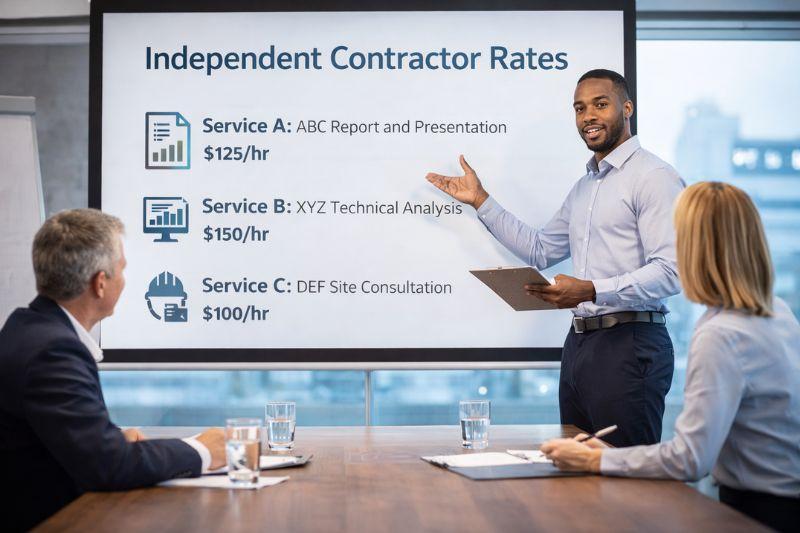
Presentation on contractor rates explaining impact of 1099 write offs

While pricing negotiations could initially surprise you, as a business owner or HR professional, you want a contractor who correctly structures their pricing. Why? Because it saves you from dealing with worker misclassification, reflecting genuine business independence.

Let’s look at one such scenario. Assuming that you decide to hire a sole proprietor to travel around the country, pitching presentations to high-level execs. They’re an expert in renewable energy sources for AI data centers. You agree on an hourly rate and that you’ll pay for their business trip airfare, travel expenses, personal expenses, and their office supplies and equipment. This spreads the cost of hiring the contractor around and doesn’t require you to hire a full-time renewable energy expert.

Come tax time, they realize they can’t significantly reduce taxable income because they’ve paid most of their expenses, and that the working relationship lacked clear independence - they were really an employee of your company without the additional benefits. This is the type of structure that increases the risk of worker misclassification.

Avoiding this requires a clear distinction between your business and the business activities of the contractor (including their business expenses). Achieve this, and you’ll significantly reduce risks.

For international engagements, compliance becomes even more complex. We explain these cross-border considerations in this guide on how to hire international contractors.

When to consider an Employer of Record

There are scenarios in which hiring an independent contractor may not be the best solution for your company because it will lead to operational inefficiencies, worker misclassification, or other compliance risks. These scenarios might look like this:

  • Long-term, full-time workload where you control how the person works and supply the resources for the work. Possible risk: Worker misclassification.
  • The work is a core business function, and would give the contractor authority to make important business decisions. Possible risk: Worker misclassification and compliance risk.
  • Regulatory scrutiny in jurisdictions where worker classifications are strict. Possible risk: Worker misclassification and financial burden.

In these cases, a hiring model that includes partnering with an Employer of Record (EOR) could be a better alternative to hiring contractors. They act as the legal entity or employer, dealing with payroll, taxes, and compliance issues related to full-time employment, and you retain the day-to-day working relationship with the employee. The EOR charges a monthly fee and becomes your partner in hiring the right employees for your business.

Rivermate offers access to 150+ countries, and 100+ experts around the world, working 24/7 to provide you with personalized, and human first EOR services. No digital assistants, no bots. Just real people helping you with your hiring needs. Speak to a Rivermate expert about whether you need an employee or a contractor.

Conclusion

1099 write-offs are allowable business expenses that contractors deduct to reduce their taxable income. These write-offs can be of significant benefit to the contractor if they are handled correctly. When you hire a contractor, you are not required to withhold any taxes or pay for business expenses. But they can influence your hiring model in the following three ways:

  • They affect how contractors price their services.
  • They serve as evidence of financial independence, thus avoiding worker misclassification.
  • They increase compliance risks when the who-pays-for-expenses is not clearly defined.

For companies interested in hiring contractors, understanding how 1099 write-offs impact contractor rates helps you to interpret their rates accurately. It also helps you make decisions about payment of certain expenses and to structure contractor agreements correctly.

An Employer of Record, like Rivermate, can help you employ remote workers or independent contractors globally, while reducing compliance and misclassification risks. The contractor agreement is drawn up by them, they receive contractor invoices, and ensure speedy payment through their platform. Your role? To manage the day-to-day working relationship, and if you have multiple contractors across the globe, you can manage them all through the Rivermate platform. Learn more about any country you want to hire in with Rivermate’s country guides.

FAQs: 1099 write-offs

1. What can 1099 employees write off?

1099 contractors can deduct legitimate expenses for business purposes.

The most common tax deductions are home office costs, vehicle expenses, travel expenses, equipment, software subscriptions, internet, phone bills, health insurance, lease payments, and retirement savings. These eligible deductions are allowed by the IRS as a way to lower taxable income for self-employed individuals.

2. What are common 1099 tax mistakes?

Common 1099 tax mistakes include mixing personal and business expenses, overstating home office expenses, failing to make quarterly estimated tax payments, and not making use of tax savings afforded to the self-employed.

Contractors should only claim the business portion of their expenses, and deduct home office expenses strictly according to IRS guidelines. Improper claims or documentation can trigger audits and even penalties.

3. What is the difference between gross income and taxable income for a contractor?

For a contractor, the gross income is the amount of money received before any expenses have been deducted. Gross income represents money received from all clients (and reported on form 1099-NEC), plus any other business income such as interest and dividends.

Lenders will use this amount to calculate the earning potential of your business. Taxable income is the portion of your gross income that is subject to taxation. You can reduce this portion by deducting the costs of running your business, such as home office expenses, advertising, business meals, travel, and insurance.

4. How do I know if my business expense qualifies for a 1099 write-off?

Most 1099 write-offs are defined by the Internal Revenue Service. The expense must be incurred as a direct result of business activities and generating an income.

Examples of deductions are business travel expenses, business vehicle cost and maintenance, insurance premiums, equipment and supplies, professional services (such as bookkeepers or lawyers), and labor costs. Business start-up costs are also viewed as deductions. Personal expenses such as meals, household items such as furniture, cosmetics, clothing, leisure holidays, personal technology, and transport costs do not qualify for 1099 write-offs.

5. Should I pay my contractor's business expenses?

Ideally, there should be a clear line between your own business and that of the contractor. For this reason, it is not a good idea to pay their business expenses.

When businesses pay for these expenses erodes an important element of contractor classification, which is independence. This means they must have their own business processes, pay for their own expenses, and claim their own tax deductions. Contractors should rather adjust their hourly rates to accommodate payment of business expenses.

Social Share:

Rivermate | background
Lucas Botzen

Founder & Managing Director

Lucas Botzen is the founder of Rivermate, a global HR platform specializing in international payroll, compliance, and benefits management for remote companies. He previously co-founded and successfully exited Boloo, scaling it to over €2 million in annual revenue. Lucas is passionate about technology, automation, and remote work, advocating for innovative digital solutions that streamline global employment.

Rivermate | background
Team member

Hire your global team with confidence

Our Employer of Record (EOR) solution makes it easy to hire, pay, and manage global employees.

Book a demo