




Rivermate logo

Global Employment Guides

19 mins read

Best EOR Services in France: 2026 Guide for Employers

Published on:

Jan 16, 2026

Updated on:

Jan 16, 2026

Rivermate | Best EOR Services in France: 2026 Guide for Employers

Best EOR Services in France: 2026 Guide for Employers

France is one of Europe’s most appealing places to hire, but it is also one of the most regulated. You have access to highly skilled talent, strong IP safeguards, and a mature, professional workforce. The trade-off is a demanding compliance environment: strict labor rules, significant employer social charges, and payroll that can get complicated fast.

For international companies that want to build a team in France without setting up an expensive local entity, an Employer of Record (EOR) is often the most practical route. The EOR becomes the legal employer on paper and takes on the administrative and legal workload—drafting compliant employment contracts, running payroll, managing social security reporting and payments with URSSAF, administering required benefits, and ensuring day-to-day compliance with the Code du Travail.

What makes France especially complex is the amount of structure employers must follow. Employer social contributions commonly sit around the 25–30% range, employees must be enrolled in a mutuelle (top-up health coverage), and terms can vary materially depending on the applicable collective bargaining agreement, of which there are hundreds across sectors. An EOR helps you navigate these requirements, hire in days rather than months, and reduce exposure to permanent establishment risk that can come with forming a local subsidiary.

10 Best EOR Services in France - Overview

Provider Best For Why It Stands Out
Rivermate Best overall EOR for France Strong compliance, accurate payroll, France-ready contracts
Rippling HR + IT automation Combines EOR with full HRIS, devices & app management
Remofirst Budget-friendly hiring Affordable pricing with reliable French payroll
Deel Fast global scaling Excellent UI, strong compliance, quick onboarding
Oyster HR Remote-first teams Simple platform, strong global compliance
Skuad Startups hiring in France Low-cost, fast onboarding, good automation
Gloroots Transparent pricing Clear compliance workflows and predictable pricing
Remote Tech-focused teams Strong automation and contractor support
Multiplier SMEs expanding to France Cost-effective with multilingual support
Mercans Compliance-heavy enterprises Deep payroll expertise and strong governance

1. Rivermate

Best for: Overall EOR performance & France-focused compliance

Pros

  • Full compliance with French Code du Travail
  • Accurate French payroll: URSSAF, social charges, employer taxes
  • Expertise with CDI, CDD, and probation periods
  • Fast onboarding with France-ready contracts
  • Local HR support for paid leave, RTT, sick leave
  • Smooth, compliant offboarding

Cons

  • Fewer enterprise HR integrations than Rippling
  • No IT/device management
  • Not ideal for highly complex multinational governance

Description

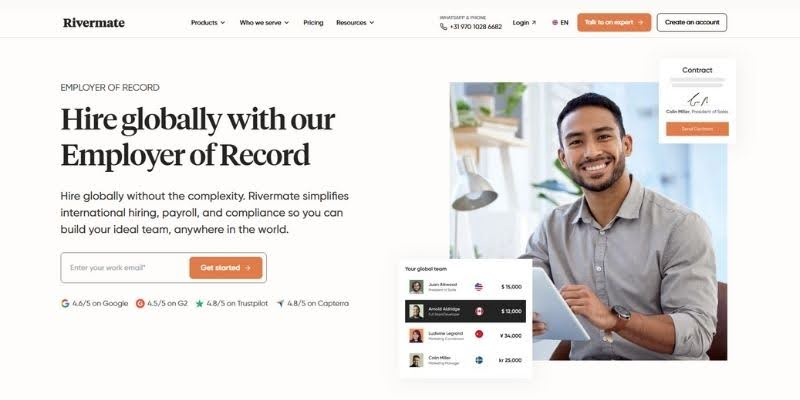
Rivermate is a global Employer of Record (EOR) that’s especially strong in France, where hiring and payroll can get complicated fast. If you’re employing someone in France without setting up a local entity, Rivermate helps you do it properly from day one, with contracts and processes built around French labor regulations rather than generic templates.

On payroll, Rivermate covers the full French stack: URSSAF declarations and contributions, employer social charges, and mandatory pension components such as AGIRC-ARRCO, along with unemployment-related requirements (Unédic) and common family allowance obligations. The platform is also familiar with the practical HR realities that trip companies up, like structuring CDI vs. CDD contracts correctly, setting probation periods in line with role level, and ensuring written agreements are in place before the employee starts.

Beyond payroll, Rivermate supports France-specific leave administration (paid annual leave, RTT where applicable, and sick leave workflows), helps coordinate mandatory benefits such as mutuelle health coverage (including the employer contribution requirement), and manages offboarding in a way that aligns with French notice periods and compliance expectations. For startups and lean global teams expanding into the French market, it’s a solid fit when you want “France-ready” compliance and local HR guidance without the overhead of enterprise-grade complexity.

Pricing: €299 per employee per month

2. Rippling

Best for: Companies wanting EOR + full HRIS + IT automation in France

Pros

  • Full HRIS plus device, app, and identity management
  • Strong automation engine
  • Good French payroll accuracy
  • Excellent UX
  • Robust integrations

Cons

  • Premium pricing
  • Some EOR operations rely on partner entities
  • Too complex for very small teams

Description

Rippling brings HR, IT, and finance together in one platform, and it can support French hiring through an EOR setup, meaning you can centralize the employee lifecycle from onboarding to payroll in a single system, while keeping the heavy lifting of France-specific compliance more automated and less error-prone.

Where Rippling tends to stand out is operational consistency for distributed teams. If you’re already thinking beyond “just payroll,” the ability to tie onboarding workflows to IT tasks (like device provisioning and app access), then connect that into time tracking and payroll, can reduce a lot of manual handoffs. The experience is also stronger when you need French localization beyond the basics, like mandatory benefits setup, required reporting, and country-specific payroll rules.

Rippling can be a strong fit if your priority is unified workflows, deep automation, and building a scalable HR/IT foundation. If you want a straightforward EOR-only solution with minimal tooling overhead, a more focused provider is often the better match.

Pricing: Custom

3. Remofirst

Best for: Budget-friendly France EOR hiring

Pros

  • Very affordable
  • Fast onboarding
  • Simple UI
  • Solid payroll compliance (social charges, taxes)

Cons

  • Limited enterprise features
  • Smaller integration ecosystem
  • Less global brand recognition

Description

Remofirst is a cost-effective solution popular with early-stage teams and startups hiring their first French employees. The platform generates CDI and CDD contracts compliant with French employment law, handles reliable French payroll including all social charges and tax obligations, and manages benefits administration with transparent pricing. Remofirst's no-hidden-fees approach makes budgeting predictable for growing companies.

The platform works well for companies hiring small teams (1–20 employees) in France and valuing simplicity over enterprise depth. Its strong API integration options allow teams to plug payroll and HR features directly into existing systems, reducing manual data entry. Remofirst is less suitable for companies requiring advanced analytics, complex multinational governance, or deep customization, but for speed and affordability in French compliance, it delivers solid value.

Pricing: ~US$199 per employee per month

4. Deel

Best for: Global teams needing fast France onboarding + strong compliance

Pros

  • Excellent French compliance coverage
  • Fast onboarding
  • Great UI and payroll automation
  • Localized benefits
  • Extensive global footprint

Cons

  • Premium pricing
  • Some complex invoice add-ons
  • Heavy features may overwhelm small teams

Description

Deel is a leading global EOR platform and is often considered a strong option for hiring in France, especially if you care about moving fast without losing compliance coverage. In practice, it supports the core French employment requirements: running payroll with the right taxes and statutory social charges, keeping benefits aligned (including mutuelle expectations), tracking paid leave accrual, and managing RTT entitlements in a way that fits common French working-time setups. The product experience is a big part of the appeal: the interface is straightforward, and the compliance workflows are built into the platform so teams don’t have to stitch together multiple tools or rely on manual checklists.

Where Deel tends to stand out is speed paired with consistency. If you’re already operating internationally, it can function as a “single system” for hiring and managing employees across multiple countries while still handling France-specific rules correctly. That makes it a practical fit for software companies, remote-first teams, and larger multinational organizations that want one operational playbook as they expand. Pricing is generally on the premium side, but for businesses that value rapid onboarding, dependable processes, and a unified global workforce setup, the cost can be justified by the time saved and the reduced compliance risk.

Price: US$599 per employee per month

5. Oyster HR

Best for: Remote-first teams hiring in France

Pros

  • Strong French contract compliance
  • User-friendly interface
  • Clear documentation for local rules
  • Good automation

Cons

  • Higher pricing tier
  • Slower onboarding than fastest competitors
  • Fewer France-specific localized benefits than top EORs

Description

Oyster is a simplicity-first EOR built for remote-first companies and distributed teams. The platform handles French payroll taxes, statutory benefits, paid leave calculations, and compliance documentation with clear, straightforward workflows. Oyster's mission-driven approach appeals to companies that view distributed work as a core cultural value and want an EOR partner that shares that standard.

The platform works well for startups and growth-stage companies building international teams from inception, particularly those prioritizing equity compensation, immigration support, and a strong cultural fit with their EOR provider. However, Oyster's premium pricing and slower onboarding than competitors may be drawbacks for companies in fast-growth mode or highly cost-conscious teams.

Pricing: US$699 per employee per month

6. Skuad

Best for: Fast, affordable France onboarding

Pros

  • Very budget friendly
  • Fast onboarding
  • Good payroll compliance (URSSAF, contributions)
  • Simple automation

Cons

  • Fewer enterprise features
  • Limited deep integrations
  • Smaller global brand

Description

Skuad is well-suited to startups hiring their first French employees, offering strong compliance at an affordable price point. The platform generates France-ready contract templates (CDI and CDD), manages payroll with worry-free handling of URSSAF contributions, and enables rapid onboarding. Skuad's strength lies in its simplicity and speed, allowing founders to hire and onboard talent quickly without navigating complex configuration.

However, as a cost-effective entry point into French hiring, it delivers solid compliance and reliable service. Skuad is particularly popular with startups and early-stage teams testing new markets in France.

Pricing: US$199 per employee per month

7. Gloroots

Best for: Companies needing transparent EOR pricing + compliance clarity

Pros

  • Transparent pricing
  • Strong global compliance engine
  • Good French payroll & tax management
  • Solid support
  • Solid support

Cons

  • Smaller platform than major global competitors
  • Limited advanced automation
  • Fewer localized benefit partnerships

Description

Gloroots positions itself as an emerging EOR provider focused on pricing transparency and compliance clarity, which are critical concerns for cost-conscious SMBs. The platform delivers strong French labor law support, accurate payroll and tax calculations, and employment contract compliance while maintaining complete transparency about pricing breakdowns. Monthly invoices itemize exactly what you're paying for: employment costs, statutory contributions, benefits, and platform fees.

Gloroots appeals to businesses that value predictability and want to avoid surprise charges or hidden FX margins. The platform works particularly well for companies with Asia-Pacific expansion needs (where Gloroots has specialized strength) or those seeking a balance between affordability and compliance depth. For very large enterprises requiring white-glove service or extensive integrations, larger competitors may be better suited.

Pricing: Custom or mid-tier pricing

8. Remote

Best for: Tech-forward companies hiring French remote employees

Pros

  • Strong automation
  • Worry-free French payroll compliance
  • Great contractor + employee support
  • Good UX

Cons

  • Pricing higher than mid-tier providers
  • Some workflows can feel complex
  • Limited deep integrations vs Rippling

Description

Remote (Remote.com) is an automation-first EOR platform designed for tech-forward companies managing distributed teams. The platform excels at simplifying French payroll complexity through automation of DSN filings, URSSAF declarations, SEPA transfers, and benefits administration. Remote's strength lies in its technical sophistication and strong compliance automation, making it ideal for companies comfortable with modern, technology-driven HR workflows.

Remote works exceptionally well for software companies, digital-native organizations, and tech teams hiring across multiple countries. Their platform focuses on automation and their technical infrastructure appeals to engineering-led companies. However, the premium pricing and feature complexity may not be justified for very small teams or those prioritizing simplicity over advanced automation.

Pricing: US$599 per employee per month

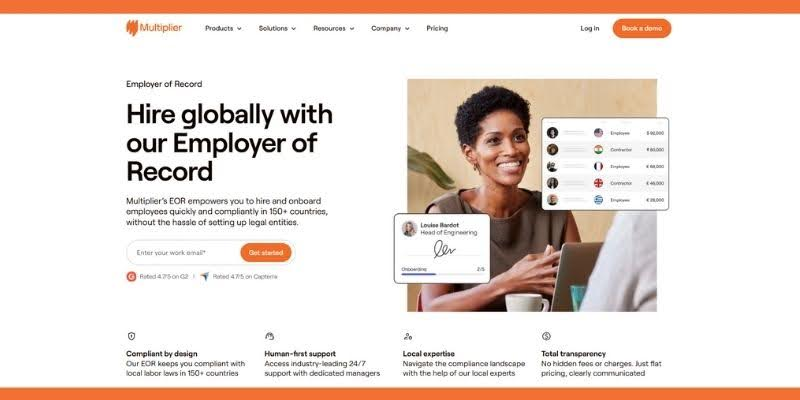
9. Multiplier

Best for: SMEs needing cost-effective France compliance

Pros

  • Good pricing
  • Accurate payroll + contributions
  • Multilingual customer support
  • Fast onboarding

Cons

  • Slightly smaller coverage than global giants
  • Fewer enterprise features
  • Less brand recognition

Description

Multiplier is a strong fit for small-to-mid-size teams (10–100 employees) seeking cost-effective French compliance with personal customer support. The platform delivers accurate payroll handling aligned with URSSAF requirements, contract drafting compliant with the Code du Travail, and ongoing compliance monitoring as French regulations evolve. Multiplier's multilingual support team is particularly valuable for non-French-speaking leadership making their first French hire.

The platform occupies a strategic middle ground between budget providers and enterprise-grade solutions, offering better automation and customer support than Remofirst or Skuad while maintaining lower costs than Deel or Rippling. Multiplier is ideal for companies planning sustained growth in France (12+ months) who value personalized support and ease of use alongside cost control.

Pricing: ~US$400 per employee per month

10. Mercans

Best for: Companies needing deep payroll + local compliance expertise in France

Pros

  • Strong European payroll expertise
  • Good compliance governance
  • Large country coverage
  • Suitable for multinational operations

Cons

  • Platform leans enterprise
  • Higher pricing tier
  • Less user-friendly than newer tools

Description

Mercans is a compliance-first payroll and EOR provider with a strong track record in Europe, including France. With 23+ years focused on global payroll, it’s generally geared toward multinationals and enterprise teams that need tight governance, clear controls, and dependable execution, backed by full-time local teams in each country.

Where Mercans stands out is the combination of local coverage and an automation-heavy payroll platform: compliance workflows are built into the process. It’s a better match for companies building larger French operations or running complex, multi-country payroll across Europe; if you’re a startup or just need a straightforward EOR setup, a simpler provider may be the more practical option.

Pricing: Custom

EOR vs. creating a French entity: What’s faster and more cost-effective?

An EOR is usually the quickest way to hire in France because you don’t need to set up a French company first. For EU nationals, you can typically get someone hired and on payroll in a few days. For non-EU nationals, it usually takes much longer, mainly because of visa/work permit steps, not because payroll is hard.

Setting up a French entity (SAS/SARL) takes more time because there are more moving parts. You have to incorporate the company, then complete several registrations (social security, tax, pension, etc.). Even if incorporation happens relatively fast, getting everything fully ready often takes weeks, and it’s common for it to stretch into a couple of months.

On cost, the big things (salary, employer charges, required benefits) are basically the same either way. The difference is what you’re paying on top: with an EOR, you pay a service fee and offload most compliance/admin work. With a subsidiary, you avoid the EOR fee, but you take on setup costs, plus ongoing admin and compliance effort.

So the simple rule of thumb is: if you’re hiring 1–3 people or just testing France, an EOR is usually the faster, lower-stress option. If you’re planning to hire more people and stay in France long-term, a subsidiary can make more sense once you’ve got enough headcount to justify the extra overhead.

Why French payroll is one of the most complex in Europe

France consistently ranks near the top of global payroll-complexity indexes, often alongside Germany or Belgium, and it is more intricate than payroll in many other European countries.

Much of that complexity comes from France’s comprehensive pay-as-you-go social security system, created in 1945 after World War II, which funds retirement pensions, healthcare, maternity and disability benefits, unemployment insurance, family allowances, and workplace accident coverage.

Employer contributions vary by factors such as salary level, family situation, and contract type, which is why a typical French payslip can run to two A4 pages with 50+ separate contribution lines.

Employers also have to manage multiple overlapping contribution systems, not just one set of charges. Payments run through URSSAF for core social security, AGIRC-ARRCO for supplementary pensions, and Unédic for unemployment insurance, while additional obligations include mandatory private health coverage (mutuelle) with at least a 50% employer contribution and, for many roles, “prévoyance” disability and death coverage, including a minimum 1.5% employer contribution for cadre-level employees.

In practice, employer payroll charges commonly total around 25% to 30% of gross salary, placing France among the highest in Europe.

Collective bargaining and reporting requirements add further complexity. France has around 800 sector and industry collective bargaining agreements, plus thousands of company-level agreements, each potentially setting higher minimum pay than the SMIC, additional leave, benefit entitlements, working-time rules, overtime calculations, and bonus structures such as 13th- or 14th-month pay, with the SYNTEC agreement in tech and consulting introducing detailed forfait-jour arrangements.

Payroll calculations must also account for salary ceilings, exemptions, and frequent rule updates, while employers submit the DSN every month with hundreds of data points per employee, where errors can trigger audits and penalties.

Together, these layers help explain why even large employers keep dedicated payroll specialists, and why many international companies enter France through an EOR model to reduce cost, workload, and compliance risk.

For more information on France payroll, taxes and benefits administration, please see our Employer of Record France guide.

FAQs

How fast can I hire an employee in France through an EOR?

If the hire is an EU/EEA national, timelines are usually quick. In many cases, you can go from contract signature to the first payroll run in about 2–5 days, as long as the employee’s documents are complete. EU citizens generally have the right to work in France without needing a separate work permit.

For non-EU nationals, the process takes longer because it typically involves a work permit and visa pathway, plus local registrations (including URSSAF-related steps handled through the employer setup). A realistic range is 6–10 weeks, and it can stretch further if labor market testing is required by France Travail (formerly Pôle Emploi). When that applies, it can add another 4–6 weeks.

Do I still manage day-to-day work if an EOR employs my team?

Yes—your day-to-day management doesn’t change. The EOR becomes the legal employer for HR administration purposes (contracts, payroll, statutory filings, and compliance with local employment laws), while you remain fully in charge of the actual work: priorities, deliverables, project direction, performance goals, and team processes.

How much does an EOR cost in France?

Most EOR providers charge a monthly fee per employee, commonly falling somewhere between $199 and $699 per month depending on the platform and service level. Lower-cost providers may start around $199, mid-tier options often sit around $300–$400, and premium providers commonly land in the $599–$699 range.

The bigger budget impact, though, is the full employment cost in France: the EOR fee is only one part. You’ll also need to account for gross salary, employer statutory contributions (often ~25–30%), and mandatory benefits like the mutuelle (plus any customary benefits you offer on top).

What payroll taxes apply in France?

In France, employers pay a significant portion of payroll-related social contributions (generally via URSSAF declarations). Typical employer-side items include health/maternity/disability contributions, old-age pension insurance, family allowances, unemployment insurance, and supplementary pensions. All-in, employers often budget ~25–30% of gross salary.

Employees also have deductions from their gross pay. Common items include CSG (9.2%) and CRDS (0.5%), plus pension-related deductions. On top of that, employees pay income tax at progressive rates (0–45%) depending on their personal situation. A typical range for employee contributions before income tax is often quoted around ~20–23%.

How do CDI and CDD contracts work in France?

A CDI (Contrat à Durée Indéterminée) is the standard permanent contract in France. It doesn’t have an end date and continues until either party terminates it following the required process and notice. While a CDI can be verbal in rare situations, in practice you should treat a written contract as the norm and include the key terms (role, salary, working time, location, and relevant framework such as the collective agreement). Probation periods often fall around 2 months for manual/admin roles, 3 months for specialists, and 4 months for cadres/executives, with typical notice periods ranging 1–3 months depending on seniority and context.

A CDD (Contrat à Durée Déterminée) is a fixed-term contract and is more restricted. It’s only allowed for specific legal reasons (for example: replacing an absent employee, a temporary activity increase, or seasonal work). It cannot be used to cover a normal, permanent need. A CDD must clearly define the end date (or a precise end condition) and has limits on duration, often cited as up to 18 months, with renewals possible up to 36 months total depending on the situation. Probation is typically calculated as 1 day per 5 days worked, with caps depending on contract length (commonly 2 weeks for contracts under 6 months and 1 month for contracts over 6 months). If a CDD transitions into a CDI at the end, there are formalities around written confirmation within a required timeframe (noted as a 2024-linked change in some guidance).

How does French social security work for employers?

French social security contributions are administered through monthly payroll reporting, typically via the DSN (Déclaration Sociale Nominative). Employers register and report payroll data so contributions can be collected and distributed across the relevant institutions. URSSAF acts as the collection body for many of these contributions and channels funds to entities such as CPAM (health insurance), CNAV (retirement), CAF (family benefits), workplace injury coverage funds, AGIRC-ARRCO (supplementary pensions), and Unédic (unemployment).

These contributions are mandatory for employers with French employees, you can’t opt out. If an employer fails to register correctly or misses declarations, penalties can be severe (often described as significant surcharges on amounts owed, with escalation risk depending on the situation). This is one of the main reasons companies use an EOR in France: it reduces operational risk by keeping registrations, filings, and payroll compliance tightly managed.

What are the benefits of using an Employer of Record (EOR)?

An Employer of Record (EOR) makes it easier to hire employees in new countries without setting up a local legal entity. The biggest benefits are faster onboarding, reduced compliance risk, and access to local expertise to help navigate complex French employment regulations. An EOR also manages essential payroll services, statutory filings, and required benefits.

Social Share:

Rivermate | background
Lucas Botzen

Founder & Managing Director

Lucas Botzen is the founder of Rivermate, a global HR platform specializing in international payroll, compliance, and benefits management for remote companies. He previously co-founded and successfully exited Boloo, scaling it to over €2 million in annual revenue. Lucas is passionate about technology, automation, and remote work, advocating for innovative digital solutions that streamline global employment.

Rivermate | background
Team member

Hire your global team with confidence

Our Employer of Record (EOR) solution makes it easy to hire, pay, and manage global employees.

Book a demo
Best EOR Services in France: Comparison Guide | Rivermate