



Global Employment Guides
Best EOR Services in Denmark in 2026
Explore the best EOR services in Denmark. Compare top providers, pricing, and features to hire Danish employees easily and stay fully compliant.
Lucas Botzen
Global Employment Guides
20 mins read


Our Employer of Record (EOR) solution makes it easy to hire, pay, and manage global employees.
Book a demoHiring in Denmark can be deceptively complex if you don’t already have an entity on the ground. It’s not just “European employment law” in a general sense; Denmark runs heavily on collective bargaining agreements (CBAs), industry norms, and tightly coordinated reporting across payroll and tax systems. Get the basics wrong (holiday pay handling, statutory contributions, payslip requirements, or working environment obligations) and the risks add up quickly—especially once you’re employing more than one person.
That’s why many international teams skip the subsidiary route at the start. Setting up a Danish company can take time, legal effort, and ongoing administration, often before you’ve validated your first hire. An Employer of Record (EOR) solves the “legal presence” problem immediately: the EOR becomes the formal employer in Denmark, while you manage the person’s work, priorities, and performance day to day.
In practice, a good EOR in Denmark isn’t just running payroll. They should be able to guide you through the real Denmark-specific friction points—like whether a role is likely to fall under a CBA, how probation and termination terms are typically structured, what benefits are expected in your sector, and how to keep documentation clean if you ever need to make changes later.
This guide compares seven EOR providers that can support hiring in Denmark in 2026. The focus isn’t marketing claims, it’s the factors that actually affect speed, compliance confidence, cost predictability, and the employee experience once your hire starts.
| Service Provider | Ideal For | Primary Strengths |
|---|---|---|
| Rivermate | Organizations valuing relationship-driven support | On-demand expert access, unified platform architecture, consistent pricing transparency |
| Deel | Companies managing mixed employment models | Robust contractor capabilities, integrated HR functionality, rapid support resolution |
| Remote | Tech-focused expanding organizations | Direct entity ownership, published fee structure, minimal onboarding delays |
| Papaya Global | Multi-national corporations scaling rapidly | Consolidated payment infrastructure, high-volume processing, enterprise automation |
| Safeguard Global | Mid-to-enterprise operations | Regional specialist networks, itemized invoicing, customizable service tiers |
| Velocity Global | Organizations with complex visa requirements | Visa navigation expertise, cross-border coordination capabilities, immigration support |
| Globalization Partners | Established enterprises managing growth | Widest geographic coverage, dedicated partnership models, intellectual property safeguards |
Rather than applying generic software evaluation criteria, we assessed EOR providers against dimensions that specifically impact Denmark hiring success. This framework recognizes that EOR providers operate through fundamentally different business models, yet each can serve particular organizational needs effectively.
Expertise in Danish labor law and collective agreements determines whether an EOR can navigate Denmark's distinctive employment landscape. The country has no statutory minimum wage; instead, collective agreements negotiated between unions and employer associations establish wage floors for specific sectors. Approximately 82% of private sector workers operate under collective agreements, meaning your EOR must understand sector-specific terms, notice periods, redundancy procedures, and benefit floors.
Infrastructure for local employment without establishing Danish entities enables rapid market entry. We examined whether providers operate their own legal entities in Denmark or rely on local partner networks, as this directly affects compliance consistency and operational speed.
Accuracy of Danish payroll processing involves correctly calculating the 8% Labor Market Contribution paid by employers, withholding employee income tax through Denmark's eIndkomst digital system, managing ATP pension fund contributions based on salary levels, and accurately accruing the mandatory 12.5% holiday pay fund. Small mistakes in these calculations trigger compliance violations.
Administration of mandatory and discretionary benefits includes statutory requirements like occupational accident insurance, supplemental unemployment insurance through the ATP system, and optional offerings like private health coverage and professional development stipends.
Speed of employee onboarding directly influences your ability to capitalize on market opportunities. We measured realistic onboarding timelines for both Danish nationals and non-EU talent requiring work permits.
Caliber of ongoing compliance support becomes critical as employment relationships evolve. Handling compensation changes, benefit modifications, and terminations under Danish law requires specialized knowledge that extends beyond initial setup.

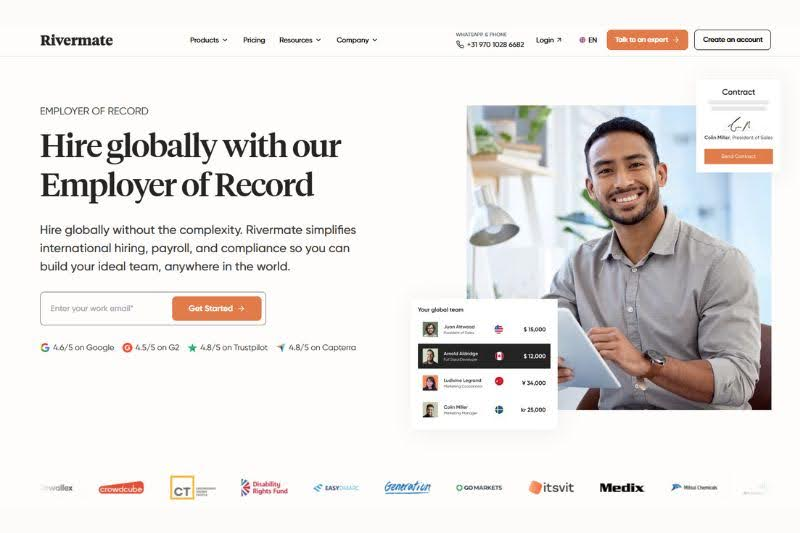
Rivermate is a strong option for hiring in Denmark if you want two things at once: solid local execution (contracts, payroll, reporting) and support that doesn’t disappear after onboarding. It’s built for teams that don’t have in-house Denmark expertise yet, but still want a clean, compliant setup from day one—without juggling multiple vendors.
Comprehensive compliance automation: Rivermate generates Danish-compliant employment contracts that cover the practical details companies often miss when hiring locally—probation structure, working hours expectations, notice/termination language, and mandatory employment terms. The workflow is designed to reduce back-and-forth while keeping documentation consistent across hires, even if you’re adding roles over time.
End-to-end payroll processing: Rivermate runs Denmark payroll monthly and handles the common Denmark-specific payroll components as part of the process (labor market contribution, tax withholding/reporting, ATP contributions, and holiday pay accrual). Payments are made in local currency to Danish bank accounts, and payroll outputs are organized so finance teams can reconcile runs quickly and track changes month to month.
Flexible benefits administration: Rivermate supports mandatory benefits and statutory leave management, with room to layer on additional benefits that are competitive in Denmark (for example, private health coverage, wellness allowances, or learning budgets). This is useful if you’re hiring in a competitive market where “baseline compliance” isn’t enough to close candidates.
Rapid onboarding: Rivermate’s onboarding process is streamlined so employees can typically be onboarded quickly once documentation is complete. For non-Danish hires, Rivermate coordinates the work authorization assessment process so you’re not piecing together requirements yourself. This reduces delays that often happen when immigration steps are treated as an afterthought.
Unified global dashboard: Hiring, payroll, benefits, time off, expenses, and compliance tasks sit in one place. For teams hiring across multiple countries, this prevents “Denmark being managed differently” and gives HR and finance a single view of what’s happening—especially helpful around payroll cutoffs, leave tracking, and cost reporting.
Dedicated support network: Rivermate provides hands-on support through channels teams actually use (Slack, WhatsApp, email), backed by local and global specialists. That matters most in moments like: first payroll run, contract updates, employee questions about leave/holiday pay, or when you need a clear answer quickly instead of a ticket queue.
When evaluating Rivermate for your Denmark operations, clarify these critical details to ensure their services align with your specific hiring needs and compliance requirements.

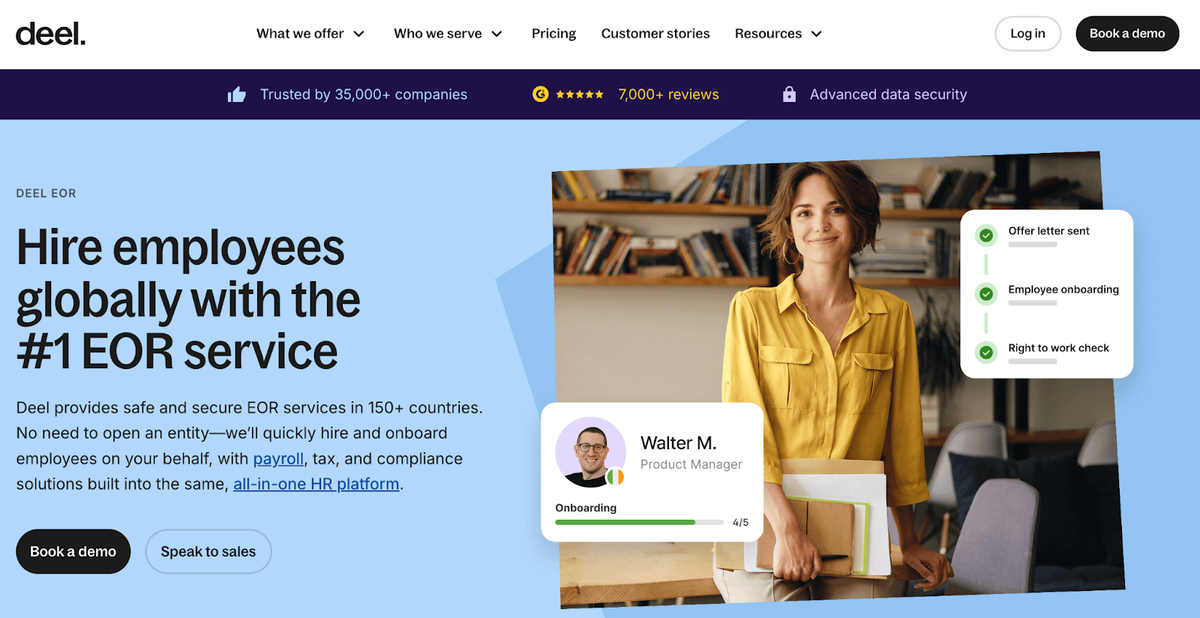
Deel has established itself as one of the most comprehensive global EOR platforms, offering a unified solution for hiring employees and contractors across 150+ countries. Their strength lies in a fully integrated HRIS (Human Resources Information System), powerful compliance automation, and strong support infrastructure.
Owned legal entity in Denmark: Deel directly operates its own Danish legal entity rather than relying on local partners, ensuring consistent service quality and direct control over compliance.
Integrated HRIS platform: Beyond payroll and compliance, Deel provides a complete HR suite including org charts, employee directories, benefits enrollment, and company announcements accessible through an employee app.
Native payroll engine: Deel's proprietary payroll system operates across 50+ countries with localized calculation engines for each jurisdiction, ensuring accurate handling of Danish taxes, social contributions, and statutory deductions.
Advanced compliance automation: The platform includes a comprehensive Knowledge Hub with legal, tax, and labor guidance curated by experts for 150+ countries. Real-time compliance monitoring ensures your Denmark operations stay aligned with evolving labor laws.
Contractor and employee flexibility: Deel supports both employee EOR and contractor engagement within one platform, allowing you to scale flexibly between permanent and contingent workers.

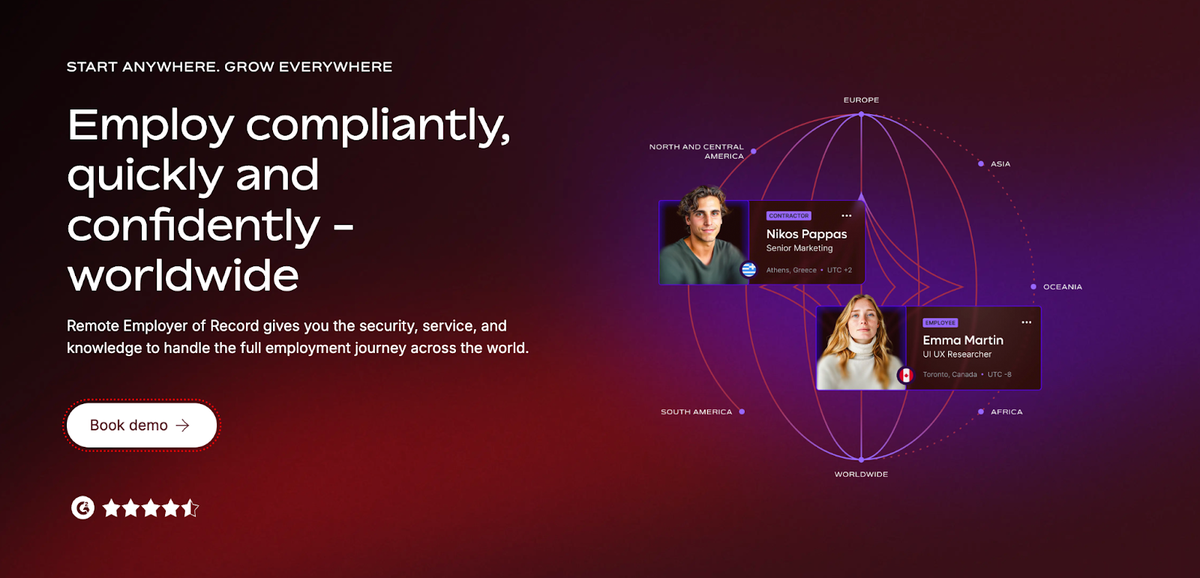
Remote has built its reputation on transparency, speed, and direct entity ownership. The company operates its own legal entities in each country where it provides Employer Of Record services, avoiding reliance on third-party partners and enabling rapid onboarding.
Owned Danish entity: Remote directly owns and operates its legal employment entity in Denmark, providing you with full control and consistency in compliance management without third-party dependencies.
Transparent pricing structure: Remote offers clear pricing with no hidden fees: $599/employee/month for EOR services, with contractors starting at $29/month plus optional premium coverage.
Rapid onboarding: Remote's streamlined process enables onboarding typically within days of documentation submission, allowing you to hire top talent quickly without delays from entity setup or partner coordination.
Fair Price Guarantee for contractors: With contractors, you only pay for active engagements. As your team composition changes, there are no penalties or surprise costs.
Comprehensive benefits administration: Handles mandatory Danish benefits (pension, health insurance, statutory leave) and supplements with optional coverage like private health insurance and wellness programs.
Compliant contract automation: AI-powered contract generation creates compliant Danish employment agreements with real-time updates to reflect changes in local labor law.
Papaya Global presents itself as a full global workforce platform rather than an EOR-only vendor. Beyond employing talent on your behalf, it bundles payroll operations, payments infrastructure, compliance support, and benefits administration into one system across 160+ countries. It’s built with enterprise-scale complexity in mind—especially useful when you’re managing high headcount, multiple entities, or large hiring waves.
Payments + payroll in one workflow: Papaya’s payments layer (PaymentsOS) is designed to reduce payroll fragmentation. They highlight 95% same-day payments in local currency and the ability to process 10,000+ transactions at once, which can matter when payroll is centralized or you’re running multi-country cycles.
End-to-end EOR coverage for Denmark: Papaya typically includes locally compliant employment contracts, payroll processing, statutory benefits administration, tax filing, and ongoing compliance management aligned with Danish requirements.
Benefits that match local expectations: Benefits can be configured to align with the Danish market, with optional add-ons like supplemental coverage, private health insurance, and (where applicable) equity program support.
Built for high-volume onboarding: Papaya is strongest when speed and repeatability matter—mass onboarding, hiring surges, and M&A-style ramp-ups where you need consistent processes across many hires at once.
Local expertise with global coordination: They operate with a network of in-country specialists across 160+ countries to support compliance and HR execution locally, while keeping governance centralized.
24/7 multilingual support
Support is positioned as always-on across regions and time zones, which is helpful for globally distributed HR/finance teams.

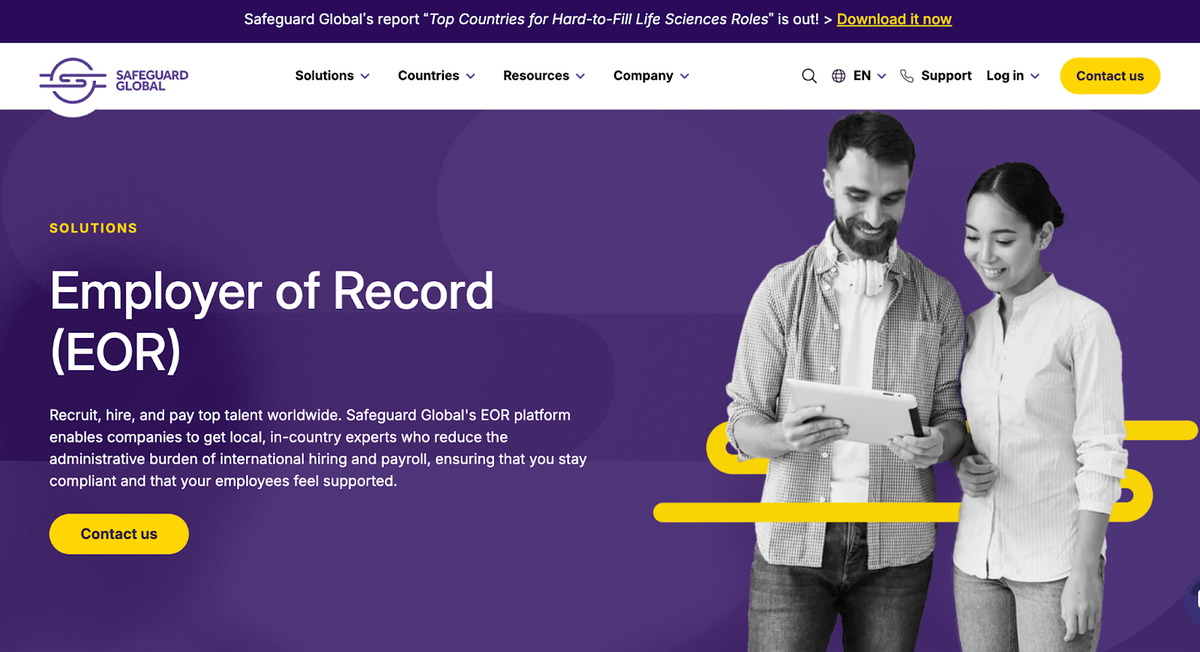
Safeguard Global is best known for handling complex, multi-country expansions where consistency, governance, and compliance reporting matter. They tend to be a strong fit for mid-sized to enterprise organizations that want a provider with mature processes, experienced specialists, and the ability to coordinate across multiple markets without things getting messy. In practice, their value shows up when you need predictable execution: clear scope, strong controls, and operational discipline across countries—Denmark included.
Denmark-first compliance execution (not just templates): Support covering Danish employment practices such as compliant contract setup, correct handling of statutory benefits, tax-related employer obligations, and alignment with local employment practices—guided by local expertise rather than purely automated workflows.
Structured cost visibility for finance teams: Billing is typically organized to make Denmark costs easier to track and reconcile—helpful if you’re comparing hiring cost-by-country, forecasting, or consolidating multi-country spend into a single view.
Local expertise backed by global coordination: Denmark delivery is supported by local specialists while an overarching account structure helps keep decision-making consistent across markets (especially useful if Denmark is part of a wider Nordics/EU rollout).
End-to-end employment administration: Coverage commonly spans onboarding and documentation, payroll inputs, benefits enrollment/administration, ongoing compliance support, and offboarding support consistent with local requirements.
Payroll operations aligned to local cadence: Processes and timelines are set up to run payroll reliably with Denmark’s statutory reporting and payroll expectations in mind, including repeatable monthly cycles and required documentation.
Service levels that scale with complexity: Organizations can typically choose lighter-touch support or more hands-on models (e.g., dedicated contacts, enhanced advisory support), depending on how much internal HR bandwidth you have.
Velocity Global (operating under the Pebl brand) is often chosen by teams that expect mobility and immigration to be a real part of their hiring plan—not just an occasional edge case. If you’re hiring into Denmark and anticipate non-EU talent, relocation needs, or frequent cross-border movement, their immigration support can be a major differentiator. They also suit companies coordinating hires across many countries and wanting one provider to manage the operational load across jurisdictions.
Work permits and relocation support for Denmark hires: Assistance coordinating visa/work permit workflows and guiding employers through required steps—especially relevant if your Denmark roles will be filled by non-EU candidates or if you’re relocating employees from other markets.
Multi-country payroll coordination with Denmark in the mix: Practical support for running payroll across multiple jurisdictions while keeping Denmark processes on schedule—useful when Denmark isn’t your only country and you want consistent coordination.
Central platform visibility: Their platform is typically positioned around giving HR/finance teams an at-a-glance view of headcount, costs, and employment status across countries, which helps when Denmark is one of several active markets.
Local delivery via partner network: Denmark employment support is commonly delivered through in-country partners, enabling faster entry in many markets—while putting more importance on governance and service consistency.
Benefits handling with local alignment: Support for statutory benefits plus the ability to structure supplemental benefits consistent with what Danish employees expect, depending on role and market norms.
Always-on support model: Global coverage across time zones is designed to reduce bottlenecks when immigration steps or employee issues can’t wait for “local business hours.”

G-P is one of the more established names in the EOR space, known for working with larger, enterprise-style teams that need structure, governance, and hands-on support across multiple markets. They’re often a fit for companies managing complex international hiring programs rather than “one-off” hires.
Wide country coverage: G-P supports hiring in 200+ countries, using a mix of owned entities and local partners depending on the market.
Enterprise support model: Larger clients typically work with a dedicated account team, which can help when hiring plans involve multiple roles, countries, or internal stakeholders.
Compliance tooling: Their platform is built to standardize employment workflows (contracts, local rules, payroll processes) across jurisdictions.
Security and IP considerations: Strong focus on enterprise-grade controls—useful for tech companies or teams handling sensitive data and IP-heavy work.
Immigration help when needed: Support for visas and work permits, particularly relevant if you’re relocating talent or hiring across borders.
Advisory add-ons: Access to market insights like salary benchmarks and local hiring context to inform expansion decisions.
An Employer of Record (EOR) hires your employee in Denmark on its local entity, while you still manage the person’s day-to-day work. The EOR takes care of the “employer” side: Danish-compliant contract, payroll, tax withholding, statutory contributions, and benefits admin. You don’t need to set up a Danish company first. It’s a practical option when you want to hire quickly without getting pulled into local admin from day one.
An EOR is the legal employer in Denmark and carries the compliance and payroll responsibility; you direct the work. A PEO is usually a co-employment model and typically assumes you already have a local entity (it’s most common in the US), so it’s not the usual route for entity-free hiring in Denmark. A staffing agency is mainly for sourcing and placing workers (often temporary), not running long-term employment compliance. If you don’t have a Danish entity and want a standard employee setup, EOR is generally the cleanest match.
For Danish or EU hires who already have the right to work, onboarding is often 1–2 business days once documents and details are submitted. The EOR issues the contract, sets the employee up in payroll, and handles required registrations. For non-EU hires, the clock is mostly immigration — work permits commonly take weeks to a couple of months depending on the route. After approval, the actual EOR onboarding step is still usually fast.
Providers usually charge a monthly fee per employee, and the price range depends on support level and what’s bundled (basic vs hands-on account management). Beyond that fee, budget for the employee’s gross salary plus mandatory Danish employment costs like holiday pay accrual and required contributions. As a planning baseline, many teams estimate around ~20% on top of gross salary for statutory costs, then refine once salary and benefits are confirmed. If immigration support matters, check whether it’s included or billed separately.
Often yes — since the EOR is the local employer, it can typically file with SIRI as the sponsor for the role. Denmark has different work permit tracks, and processing time depends on the scheme and the case, not the EOR alone. A good provider helps with the paperwork, the sequence of steps, and status updates. Just confirm up front: some EORs support immigration end-to-end, others treat it as an add-on.
That’s a normal progression: start with EOR for speed, then set up your own Danish company once you’re confident about the market. When your entity is ready, employees are moved over through a formal transfer process so payroll and registrations stay clean. The EOR handles final payroll and offboarding on their side while your entity takes over contracts and ongoing payroll. Most EORs have a standard playbook for this, so it’s usually more admin than drama.
Using Employer of Record services in Denmark helps you hire quickly and compliantly without setting up a local entity. Your EOR can handle core employment responsibilities like compliant contracts, onboarding, payroll administration, tax reporting, and ongoing HR support, reducing risk and saving internal time. It also simplifies benefits management, ensuring employees receive the right statutory and market-standard benefits while keeping you aligned with local employment requirements.
If you’re choosing an EOR for Denmark, start with what would actually hurt if something goes wrong: compliance, terminations, and the day-to-day support experience. Rivermate is a solid pick when you want a human you can reach quickly, clear flat pricing, and “tell us what you’re trying to do, we’ll handle the Denmark details.” Deel is usually the move when you want a fuller HRIS-style setup and more automation in one place, and you’re okay paying extra for that. Remote is attractive when you want something straightforward and transparent. Safeguard Global or Velocity Global typically make more sense once you’re running multi-country hiring at scale—Safeguard for broader in-country support coverage, Velocity if immigration/visas are a frequent part of the job.
The fastest way to land on the right one is to decide three things up front: (1) Will you need visa sponsorship for non-EU hires? (2) Do you need HRIS features beyond payroll and basic HR admin? (3) Do you want a dedicated person, or are you fine with a mostly self-serve workflow? Then take 2–3 demos and ask the unglamorous Denmark questions: what the timeline looks like for onboarding, what’s included in benefits setup, how they handle terminations in practice, and what reporting you actually get. And don’t accept a “starting from” price—get the all-in monthly cost in writing, with add-ons listed (amendments, offboarding, benefits, expenses), so you’re not surprised six months in.
For more information on Danish payroll, taxes and benefits, please see our Employer of Record Denmark guide.

Lucas Botzen is the founder of Rivermate, a global HR platform specializing in international payroll, compliance, and benefits management for remote companies. He previously co-founded and successfully exited Boloo, scaling it to over €2 million in annual revenue. Lucas is passionate about technology, automation, and remote work, advocating for innovative digital solutions that streamline global employment.


Our Employer of Record (EOR) solution makes it easy to hire, pay, and manage global employees.
Book a demo
Global Employment Guides
Explore the best EOR services in Denmark. Compare top providers, pricing, and features to hire Danish employees easily and stay fully compliant.
Lucas Botzen

International Employment Laws
If you want to move to the US, you may consider EB-2 visa options. Here is all about the EB-2 NIW visa, its requirements, and the application process.
Lucas Botzen

Remote Work and Productivity
Considering global hires? Discover how to effectively manage remote work as an employer with these essential tips.
Lucas Botzen