



Global Employment Guides
7 Best EOR Services in South Africa in 2026
Compare the best EOR services in South Africa. Learn how top providers handle payroll, compliance, and employment to help you hire legally and scale faster.
Lucas Botzen
Global Employment Guides
13 mins read


Our Employer of Record (EOR) solution makes it easy to hire, pay, and manage global employees.
Book a demoHiring in South Africa is a smart move. The talent pool is deep, English proficiency is strong, and you can access highly capable professionals across key functions. The catch is that employing someone locally without a registered entity can quickly turn into a compliance headache. Contracts need to align with South African labor law, payroll requires the right tax registrations and calculations, statutory filings have strict deadlines, and everyday essentials like leave entitlements and public holidays come with specific rules.
Those complexities only grow once you factor in probation periods, benefits, and the required processes around performance management and termination. Even well-intentioned companies can slip up when they’re operating from abroad, because what’s “standard” elsewhere may not hold up locally. Getting the legal foundations wrong can create expensive fixes later, from back payments to disputes, and it also puts the employee experience at risk.
An Employer of Record (EOR) solves this by becoming the legal employer on paper, while you keep full control of the employee’s day-to-day work, goals, and performance. In this guide, we compare and rank the best EOR services for South Africa in 2026, so you can pick the right provider based on how many countries you hire in, how quickly you need to onboard, and how much hands-on local support you want throughout the employment lifecycle.
We ranked these providers based on speed, compliance support, and how well they handle global workforce management as you expand into multiple countries.
| Provider | Best for | Key strength |
|---|---|---|
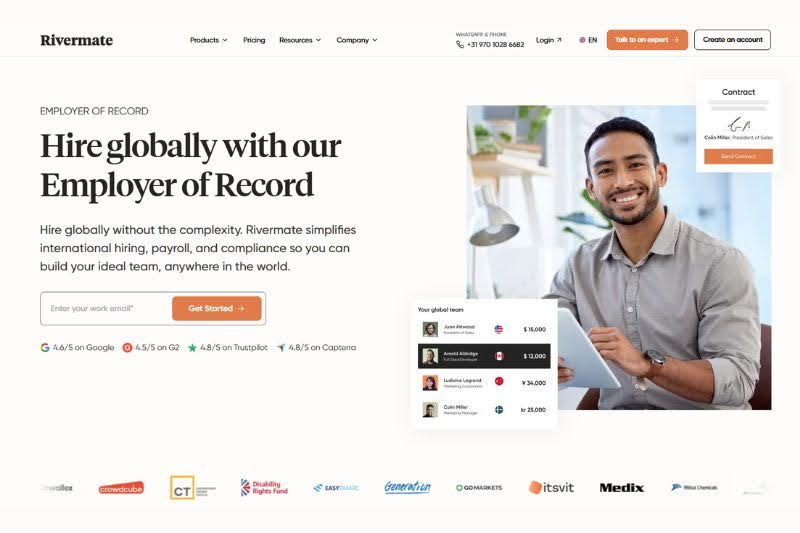
| Rivermate | Teams that want the best mix of speed + local support | Human-first support and compliant employment in South Africa, plus coverage in 180+ countries |
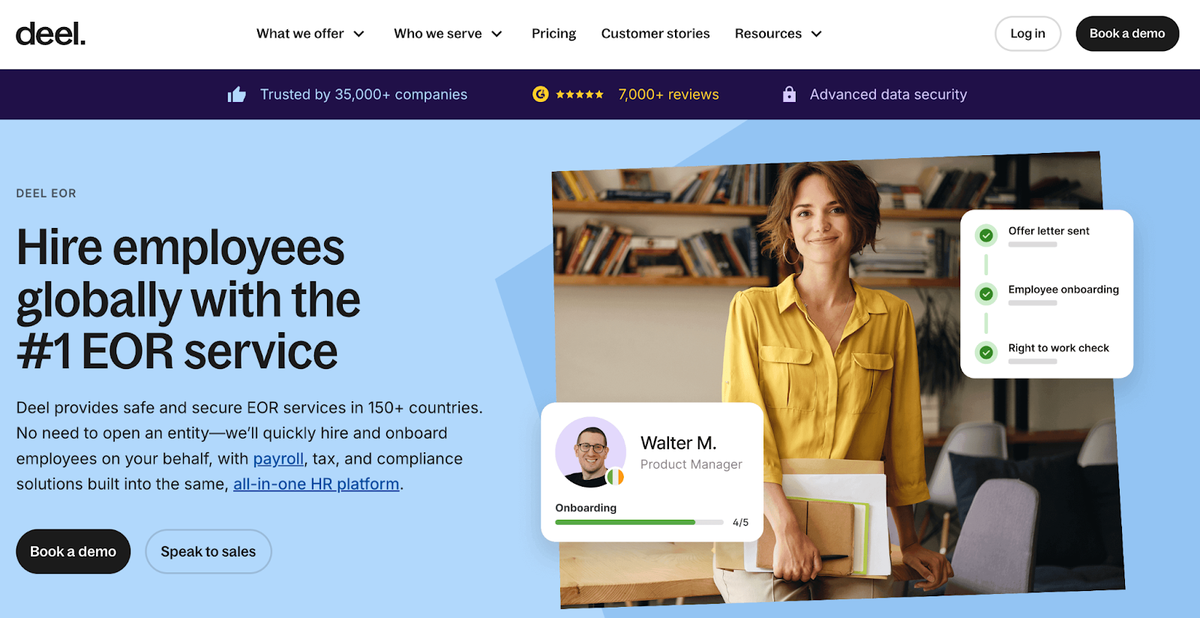
| Deel | Companies hiring across many countries (employees + contractors) | Very broad global coverage and a mature platform for multi-country operations |
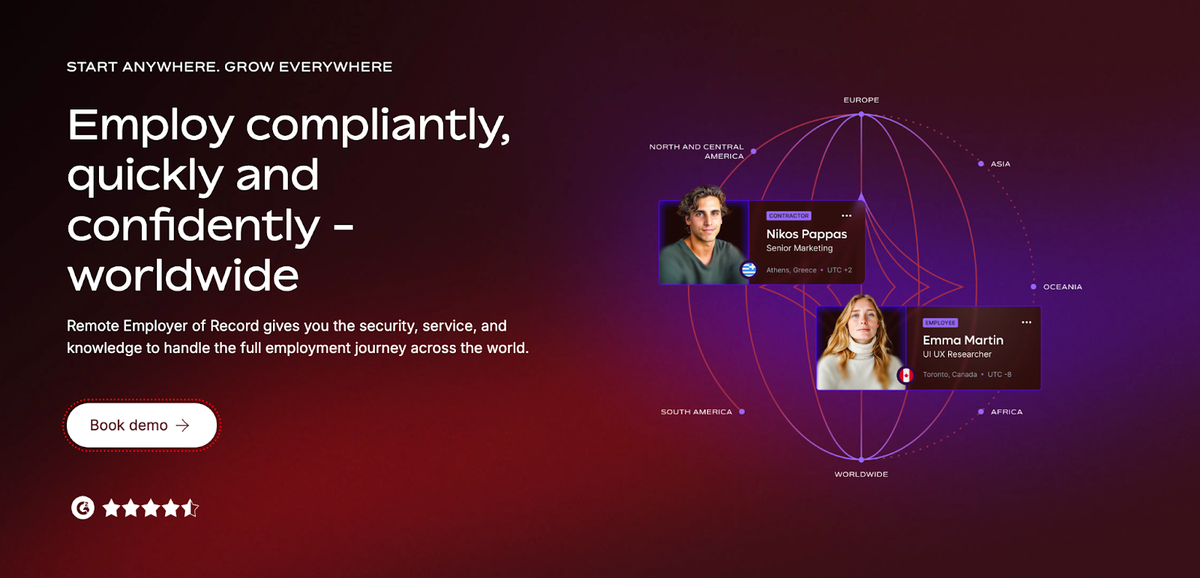
| Remote | Compliance-first teams that want consistency across countries | Owned-entity model focus and strong compliance processes |
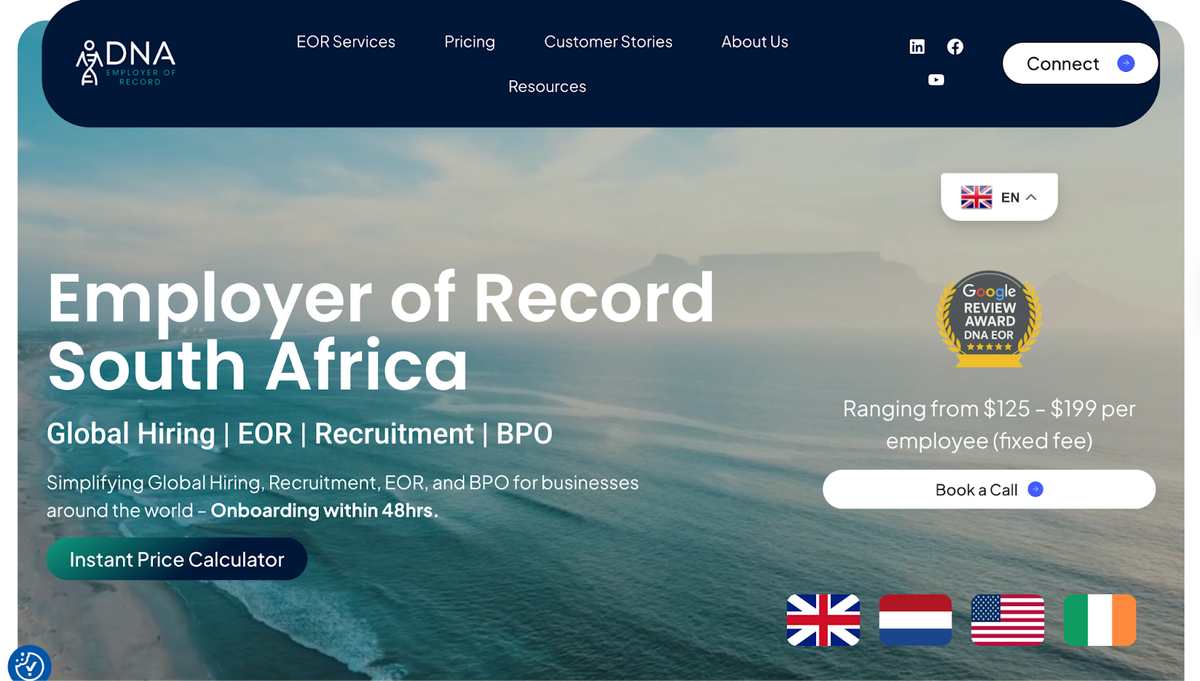
| DNA EOR | Companies that want a local South Africa-only specialist | Deep local labour expertise and hands-on HR support |
| HireJustNow | Startups and small teams hiring only in South Africa | Lean, South Africa-focused service with practical guidance |
| Papaya Global | Payroll-led global operations (mid-market to enterprise) | Automated global payroll workflows with EOR coverage in 160+ countries |
| Safeguard Global | Enterprise expansion with risk management and in-country support | In-country experts and enterprise-grade global employment support |

Rivermate is the top pick for South Africa because it balances what most companies actually need: reliable local compliance, fast onboarding, and responsive human support - without adding unnecessary complexity. You get a clear platform for contracts, payroll, and approvals, plus local expertise to keep you compliant across the full employee lifecycle (from hiring through termination).

Deel is one of the most widely used global hiring platforms, and it's a strong option if South Africa is just one part of a bigger multi-country hiring plan. It combines EOR and contractor management in one system, making it easier to standardize onboarding and payments across regions.

Remote is a popular compliance-first choice for distributed teams. It emphasizes consistent processes across countries and promotes an owned-entity approach in many markets, which appeals to companies that want tighter operational control and fewer third-party handoffs.

DNA EOR is a South Africa-focused provider built specifically for companies hiring in the country. If you want a hands-on local partner who speaks the South African labour language (contracts, policies, employee relations, terminations), DNA is a strong specialist option - especially when you do not need multi-country coverage.

HireJustNow is a South Africa-focused EOR service aimed at making compliant hiring simple for startups and small teams. If your main priority is getting 1-10 hires onboarded quickly with practical local support, it can be a good fit.

Papaya Global is best known for its global payroll platform, and its EOR offering fits teams that want centralized payroll oversight across many jurisdictions. It is often a good match for mid-market and enterprise organizations running payroll across multiple entities or needing more reporting and compliance workflows.
Safeguard Global is built for companies that need structured, risk-managed global employment support - often at enterprise scale. If your priorities are governance, local expertise, and reliable service coverage across many markets, Safeguard is a strong candidate.
If you are only hiring in South Africa, or you expect most of your hiring to stay there, a local EOR can be the practical choice. The value is not just coverage. It is judgement. Local specialists like DNA EOR or HireJustNow tend to be closer to how things work day to day, and they are often better when you need help navigating grey areas like probation questions, performance management, discipline, and terminations.
A global platform makes more sense when South Africa is one country in a wider hiring plan. Providers like Rivermate, Deel, Remote, Papaya Global, or Safeguard Global are built for consistency, with one system, standardized workflows, consolidated invoices, and reporting that still works once you add a second or third market. That matters once finance needs clean cost allocation, leadership wants a single headcount view, or your team is tired of managing different processes country by country.
In practice, many companies start local for their first South Africa hires, then move to a global EOR once they add two or more countries or need consolidated reporting. The decision comes down to what you need most right now: hands-on local labour guidance, or operational consistency across multiple markets.
For more information on South Africa payroll, taxes and benefits administration, please see our Employer of Record South Africa guide.
In South Africa, an EOR can usually get someone onboarded in 5–10 business days once the paperwork is in and the contract terms are locked. In practice, that time is mostly spent moving through a simple sequence: confirming the final offer details, issuing the employment agreement, collecting the employee’s details for payroll, and setting them up for their first pay run (plus any standard benefits enrollment).
When this slips, it’s almost always for everyday reasons—documents coming in late or with mismatched details, stakeholders asking for changes after the contract draft is underway, or a start date that’s too close to payroll processing to comfortably set everything up.
For more complex hires, 2–4 weeks is the more realistic planning range. Executive or highly tailored roles tend to involve extra review and approvals on contract clauses, more bespoke compensation structures (allowances, variable pay, special arrangements), and non-standard benefits that take longer to configure.
If background checks are required, you’re also dependent on third-party turnaround times, which can add days outside your control. The easiest way to keep timelines tight is to agree on compensation and benefits early, send a clear doc checklist to the candidate immediately, and avoid last-minute changes once the drafting and payroll setup has started.
An EOR basically becomes the employer on paper in South Africa. That means they put a South Africa–compliant contract in place, run payroll the way it needs to be run locally, handle the routine statutory deductions/submissions, and keep the core HR records you’re expected to have (leave records, employee files, payroll documents). They’ll also sanity-check the “gotchas” that often cause problems—hours/overtime, leave, and the steps you’re expected to follow if you ever need to exit someone. You still direct the work, manage performance, and run day-to-day.
Payroll runs through the EOR’s South African payroll. They calculate gross-to-net in ZAR, apply PAYE and any required deductions, and make the relevant statutory payments/submissions on schedule. You’re invoiced for the total cost (salary + employer costs/benefits where applicable + the EOR fee). The employee gets paid locally and receives a compliant payslip plus the usual payroll documentation.
Yes, because they keep you on the rails procedurally. South Africa is one of those places where “how you did it” matters as much as “why you did it.” A good EOR will help you document issues properly, follow the right steps (warnings/meetings/notices where required), and keep a clean paper trail. That doesn’t make disputes impossible, but it reduces the risk of an avoidable unfair dismissal situation.
If the role is straightforward, most hires can be set up pretty quickly—often within a week or two. Where it slows down is rarely the EOR; it’s usually waiting on the candidate’s documents, finalizing salary/benefits, and getting the contract reviewed and signed. If you want extra checks, custom clauses, or non-standard benefits, assume closer to 2–4 weeks so you’re not rushing a start date.
If you hire without a local entity (and without local HR/payroll expertise), the risk is less “one big disaster” and more a pile of small, expensive mistakes: a contract that doesn’t hold up locally, payroll tax handled incorrectly, missed filings, or poor documentation when performance issues come up. The highest-risk moment is usually termination—because if the process isn’t done properly, that’s when disputes escalate. For companies hiring their first South Africa-based role, an EOR is often the cleanest way to avoid learning these lessons the hard way.
When you hire through an Employer of Record (EOR), the employee receives all statutory benefits mandated by South African law, and these are correctly administered as part of payroll and compliance. This includes contributions to the UIF (Unemployment Insurance Fund), which provides short-term financial support during unemployment, maternity leave, or illness. Employees are also entitled to paid annual leave, sick leave, family responsibility leave, and unpaid maternity and parental leave, as set out in South African employment laws.

Lucas Botzen is the founder of Rivermate, a global HR platform specializing in international payroll, compliance, and benefits management for remote companies. He previously co-founded and successfully exited Boloo, scaling it to over €2 million in annual revenue. Lucas is passionate about technology, automation, and remote work, advocating for innovative digital solutions that streamline global employment.


Our Employer of Record (EOR) solution makes it easy to hire, pay, and manage global employees.
Book a demo
Global Employment Guides
Compare the best EOR services in South Africa. Learn how top providers handle payroll, compliance, and employment to help you hire legally and scale faster.
Lucas Botzen

Global Employment Guides
Explore the best EOR services in Denmark. Compare top providers, pricing, and features to hire Danish employees easily and stay fully compliant.
Lucas Botzen

International Employment Laws
If you want to move to the US, you may consider EB-2 visa options. Here is all about the EB-2 NIW visa, its requirements, and the application process.
Lucas Botzen