




If you are running a company that hires people outside your home country, this is for you. You are likely doing global hiring to move faster, reach global talent, and support global expansion without setting up a local entity in every market.
The hard part is that managing international contractors is no longer just “send a contract and pay an invoice.” Local labor laws, regional labor laws, tax regulations, and local regulations change often. Countries also use different tests for worker status, which increases misclassification risk. Add local currencies, cross-border fees, and local tax filings, and the administrative burden can quietly take over your week.
That is why more teams now use Employer of Record platforms for contractor management services. The best Employer of Record tools combine compliance support, locally compliant contracts, and reliable payroll services so you can scale global contractor management with less risk and more consistency.
Key takeaways
- The best EOR services for contractor management help businesses manage cross-border work with comprehensive compliance, strong compliance and risk mitigation, and clean payments in local currencies. Done right, they reduce compliance management headaches, lower the risk management load on your team, and make it easier to expand globally without building legal entities everywhere.
- Rivermate stands out when you need flexibility, human-led help, and dedicated account managers who can handle the messy edge cases that happen in real life, especially in emerging markets. That combination matters when your goal is not only global workforce management, but also calm, predictable operations as you scale.
1. Rivermate
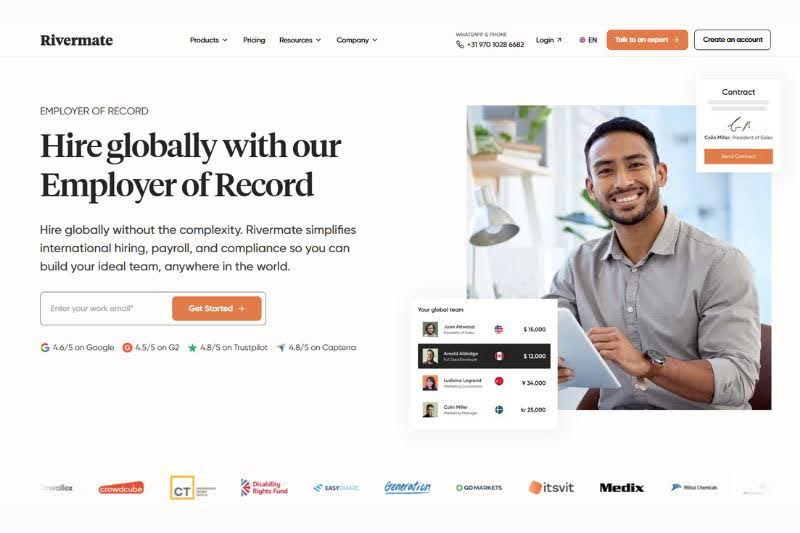
Rivermate is an Employer of Record provider built for teams that want speed, clarity, and support that feels like a partner, not a ticketing system. It is designed for global HR and workforce management across 180+ countries, with a strong focus on local compliance and practical guidance for international hiring and global contractor management.

Key features
Rivermate supports compliant contracts tailored to local laws, plus compliance support that helps you manage classification decisions and documentation as your scope evolves.
It helps businesses manage payments in local currencies and simplifies payroll management by centralizing invoices, approvals, and payout workflows, which reduces administrative tasks and overall administrative burden. It also supports contractor-to-employee transitions when a role starts to look like managing employees instead of a project-based engagement.
For more on reducing misclassification risk as you scale, see Rivermate’s guide on contractor classification and misclassification.
Best for
- Teams that want flexible global contractor management with human-led support
- Companies expanding into emerging markets and complex regions with local compliance needs
- Leaders who value dedicated account managers and consistent service quality
- Businesses that want a smooth path from international contractors to international employees
2. Deel
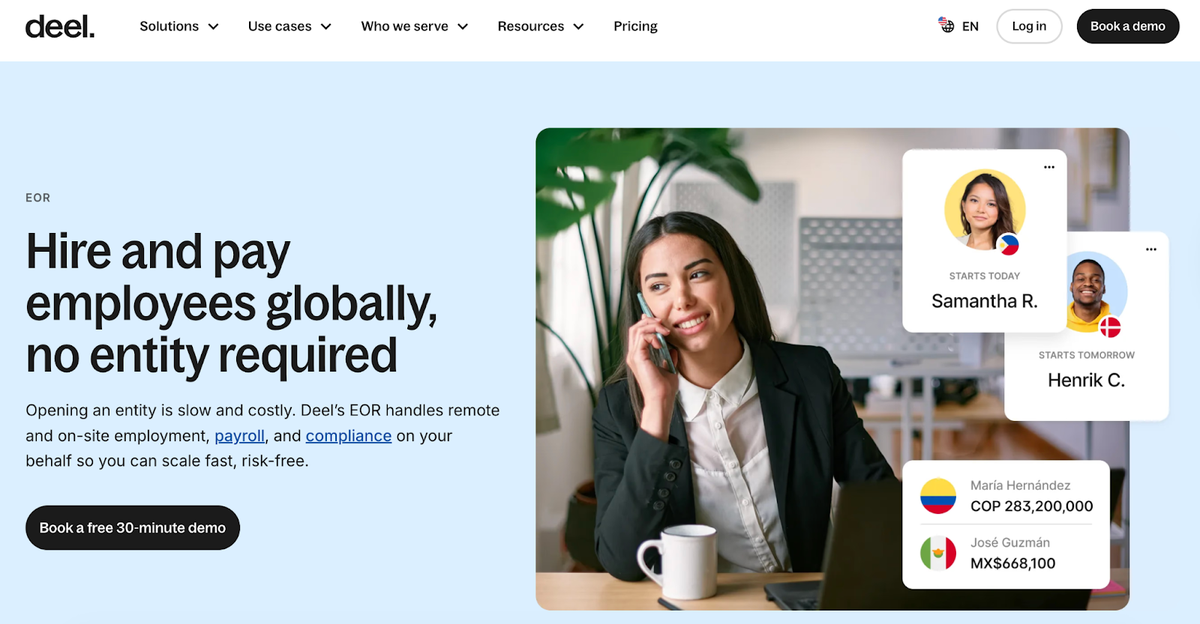
Deel is widely known for its global platform that covers contractor management and employment options, including approaches designed to reduce compliance risk and support classification decisions. It is built for fast international hiring, with automation features and broad country coverage.

Key features
Deel highlights contractor agreements, automated contract generation, and compliance management features that aim to reduce misclassification risk. It also supports global payroll processing options for paying contractors, with workflows that can include approvals, recurring payments, and documentation. Some teams use it as part of project global rollouts to standardize HR processes and manage payroll across regions.
Best for
- Fast-scaling teams that want a single global platform for contractor management services
- Companies that want automated contract generation and streamlined payments
- Teams planning future international hiring for full-time roles alongside contractors
- Organizations that want a broad self-serve product experience
3. Remote
Remote positions its contractor management software around automation, localized agreements, and risk mitigation. A notable part of Remote’s approach is its emphasis on local regulations and staying current as rules change, which matters when you have remote employees and contractors across many jurisdictions.

Key features
Remote focuses on localized contracts, compliance monitoring, and added protection options that address misclassification risk. It also supports multi-currency payments and contractor invoicing tools that reduce admin work for global contractor management. In broader global workforce management, Remote also stresses operating through direct legal entities in some contexts, which can matter when you compare providers on local compliance depth.
Best for
- Teams that want strong compliance support with ongoing compliance monitoring
- Companies hiring remote employees and contractors across multiple countries
- Organizations that want clearer guardrails around local labor laws and misclassification risk
- Teams that want structured workflows for international workforce management
4. Papaya Global
Papaya Global is often positioned for companies that want international workforce management at enterprise scale, with an operating model that connects global payroll, compliance management, and cross-border payments.

Key features
Papaya emphasizes global payroll management with workflows for tax filings and payroll taxes where applicable. It also markets contractor management with predictable operations, which is useful when finance and HR need shared visibility into employee data, invoices, and payment timelines.
Best for
- Larger organizations that need global payroll management and governance across regions
- Finance and HR teams that want visibility into payroll processing and employee data
- Companies managing complex tax regulations and local tax filings at scale
- Organizations that prioritize standardization for global workforce management
5. Oyster
Oyster is a well-known provider for distributed teams that want to hire and support people across borders while reducing compliance risk. It often speaks to the “hire globally without entities” story, which is valuable when you do not want to establish legal entities in each country.

Key features
Oyster focuses on global hiring workflows, compliance support, and benefits administration for employees. For contractor management, teams typically look for how it handles contracts, documentation, and the line between contractor work and employee management, especially when a role starts to become long-term and exclusive. Benefits management and employee benefits administration become more relevant as you convert roles from contractor to employee.
Best for
- Remote-first companies building international teams with repeatable HR processes
- Organizations that want a clear approach to employment setup and benefits administration
- Teams that expect contractor-to-employee conversions during global expansion
- Companies that want support aligned with local regulations
6. Skuad
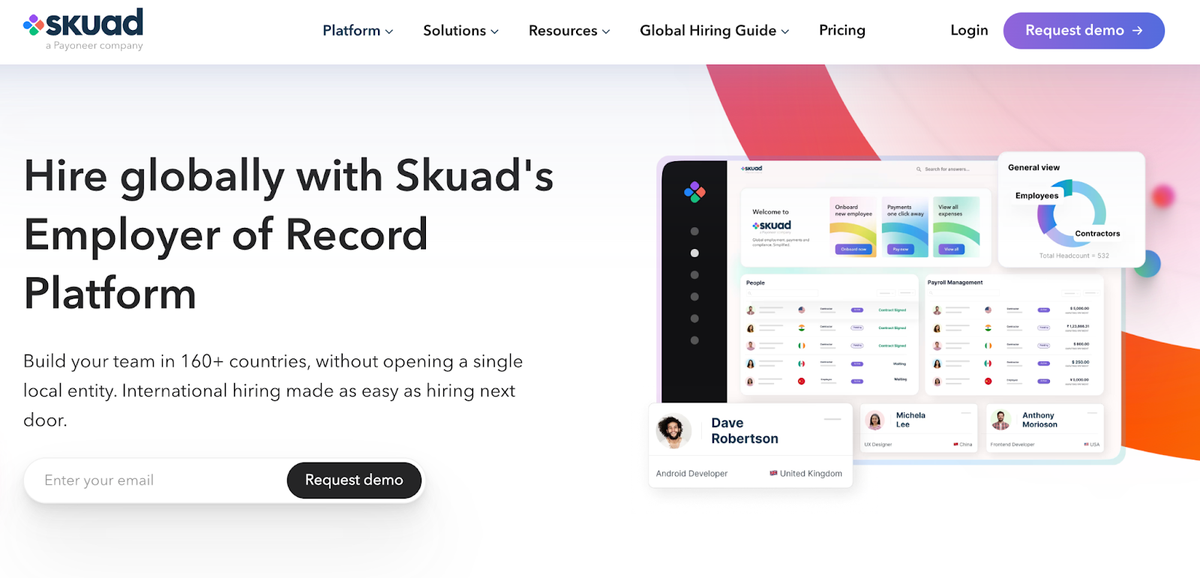
Skuad positions itself as a platform to onboard, pay, and manage international employees and contractors compliantly, aiming to reduce the operational friction of global expansion.

Key features
Skuad highlights end-to-end compliance support, payroll services, and workforce management workflows designed to reduce administrative burden. It also emphasizes local compliance requirements and helps with tax compliance documentation, which can be useful if your team is juggling tax regulations across multiple countries.
Best for
- Teams that want one workflow for global hiring, contractor management, and payments
- Companies looking to reduce administrative tasks and administrative burden
- Organizations expanding without building legal entities or a local entity in every market
- Teams that need help navigating local laws and tax compliance basics
7. Pebl
Pebl is a long-standing provider in this space, often described as supporting employment, contractor, and global talent solutions for companies expanding internationally. It is sometimes associated with broader globalization partners' style positioning in the market, where the promise is to reduce the complexity of entering new countries.

Key features
Velocity Global is commonly discussed in the context of compliance expertise, payroll services, and benefits administration, including support for employee benefits where relevant. Teams also look for dedicated account managers, which can matter when you need hands-on help with local compliance edge cases and local regulations.
Best for
- Organizations that want a mature provider for international hiring and workforce management
- Teams that prefer dedicated account management for edge cases and risk management
- Companies expanding into multiple countries where local regulations vary widely
- Businesses that want strong compliance management and benefits management support
Why use an Employer of Record (EOR) for contractor management
An EOR is traditionally used for hiring employees, where the EOR becomes the legal employer. Contractor management is different, but the compliance risk can still be serious when contractor relationships start to resemble employment. The reason companies adopt record EOR services for contractor management is simple: the legal and tax surface area grows faster than your team does.
A strong EOR partner helps you align contracts with local labor laws, maintain comprehensive compliance documentation, and reduce misclassification risk through better classification checks and ongoing compliance monitoring. This matters because local compliance rules do not only affect contracts. They also affect how you manage day-to-day work, what tools you provide, how exclusive the relationship is, and whether the person is integrated like an employee.
Authoritative guidance exists on how countries think about the employment relationship, but it is not uniform. The International Labour Organization has materials on the employment relationship that are useful for understanding why “contractor” and “employee” lines can blur in practice.
A practical rule is this: if the person is long-term, highly controlled, and functionally part of your org, you are closer to managing employees than managing a contractor. That is also the moment when converting to employment, with proper employee benefits and potentially health insurance, becomes safer and simpler.
Conclusion
Contractor management in 2026 is as much about local compliance as it is about speed. The right EOR services partner will help you manage payroll, handle global payroll processing cleanly, support tax compliance, and keep your setup aligned with local regulations as your global workforce grows.
If you want the flexibility to handle different countries, different engagement styles, and real-world edge cases without losing momentum, Rivermate is a strong option. It combines compliance expertise with human-led support, so you can expand globally with confidence and keep your team focused on building, not chasing paperwork.
Explore Rivermate’s Employer of Record services to manage global contractors compliantly and confidently.
FAQs
What are the benefits of using an EOR for contractor management?
An EOR partner can reduce compliance risk by supporting locally compliant contracts, documentation, and consistent workflows that reflect local labor laws and tax regulations. This reduces misclassification risk, supports compliance and risk mitigation, and lowers the administrative burden of contractor management services, especially when you are paying in local currencies and need a clean audit trail for tax compliance.
Can EOR services help convert contractors into full-time employees?
Yes. Many providers support transitions when a contractor role becomes ongoing or highly integrated. This is useful when you move from global contractor management to hiring international employees, because the EOR can support compliant onboarding, payroll management, benefits administration, and employee benefits administration while you keep operational control.
What are the risks of managing international contractors without an EOR?
The big risks include misclassification penalties, labor law exposure, and tax filing issues when documentation is incomplete or your practices resemble employment. Risks also show up as slow payments, inconsistent contracts, and missing compliance monitoring, which can damage trust with international teams and create downstream problems if you later need to hire them as employees through an EOR or a local entity.
How much does an EOR service cost for contractor management?
Most providers use a monthly per-worker model, sometimes with tiers based on protection level, support depth, or add-ons like dedicated account management. Some tools bundle contractor management with global payroll management features, while others price contractor management separately from EOR for employees. Instead of optimizing only for price, evaluate value: compliance support quality, how they handle local regulations, whether they offer dedicated account managers, and whether the workflow helps you manage payroll and documentation without adding more admin work.