Hiring in the U.S. is rarely as straightforward as people expect. Anyone coming from a country with one national set of labor rules usually gets surprised pretty quickly. Each state has its own idea of what employment laws should look like, and sometimes individual cities add their own twist. You might pay one type of overtime rate in one place and then discover the rules are totally different a short drive away. Most states have at least one thing that complicates life for employers. It ends up feeling less like a single market and more like a puzzle with pieces that almost fit together but not quite.
On top of the legal maze, actually finding people has become its own daily challenge. A lot of companies still cannot fill technical roles, and remote work changed everything again. It opened the door to hiring people anywhere, which sounds great, but it also means juggling several state tax systems and payroll setups at the same time. Costs have climbed too. By the time you add health insurance, taxes, and the bits and pieces that come with employing someone, the real cost is often noticeably higher than the salary number you start with. Most teams learn this only after they run the first payroll.
For companies outside the U.S. trying to build a team here, an Employer of Record ends up being the simplest path. Instead of registering a business in multiple states, they let the EOR handle the payroll, the tax forms, the benefits, and the long list of rules that keep shifting. It removes a lot of the guesswork. It also prevents the kind of paperwork mistakes that turn into expensive issues down the line. With that part handled, companies can focus on the people they want to hire rather than the administrative side of operating in the U.S.
10 Best Employers of Record in the USA: 2026 Overview
Our comparison highlights the leading EOR providers helping international companies hire employees in the U.S. without setting up a local entity. Each provider is assessed based on compliance expertise, benefits administration, tax handling, pricing transparency, and platform usability.
| Rank |
EOR Provider |
Best For |
Starting Price (Approx.) |
| 1 |
Rivermate |
Overall best EOR for hiring in the USA |
From $299/month |
| 2 |
Velocity Global |
Large multinationals expanding into the U.S. |
Custom |
| 3 |
Deel |
Fast onboarding and full U.S. payroll automation |
From $599/month |
| 4 |
Remote |
Global companies hiring distributed U.S. employees |
From $499/month |
| 5 |
RemoFirst |
Cost-conscious global hiring with U.S. payroll support |
From $199/month |
| 6 |
G-P (Globalization Partners) |
Scalable solution for companies entering multiple U.S. states |
From $650/month |
| 7 |
Safeguard Global |
Complex compliance and workforce management |
Custom |
| 8 |
Rippling |
Tech-focused businesses seeking unified HR + IT systems |
From $499/month |
| 9 |
Oyster HR |
Startups hiring remote U.S. talent with flexible pricing |
From $399/month |
| 10 |
Multiplier |
SMEs hiring quickly across multiple states |
From $350/month |
1. Rivermate – Best overall EOR
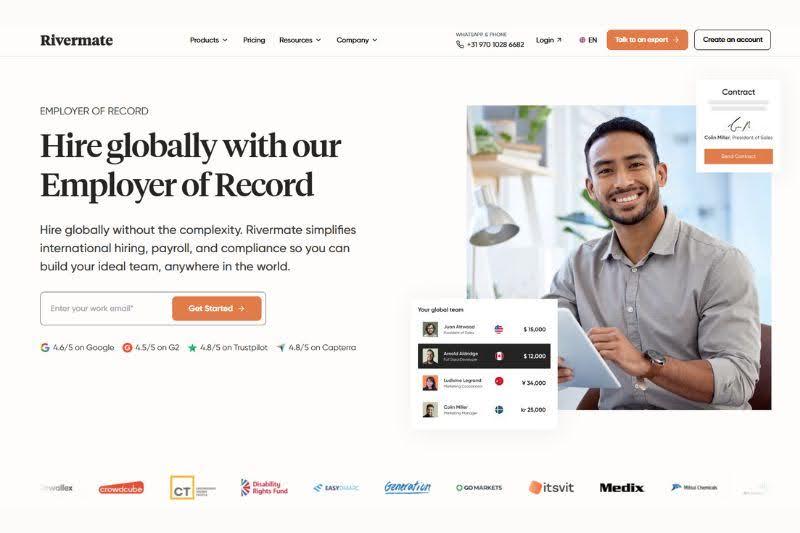
What is Rivermate?
Rivermate is an Employer of Record platform that helps companies bring on people in the U.S. and abroad without opening local entities. Instead of handling payroll in one place and contracts somewhere else, everything is in one system. It ends up making the whole process feel a lot simpler when you’re hiring across several regions.
Key features
- HR and payroll in one place
Rivermate puts the day-to-day HR tasks and payroll work in the same spot, which saves people from hopping between different systems. Everything updates in the background, so the usual manual fixes and double entries happen far less often.
- Built-in compliance support
The platform tracks local rules in every country where a company hires and adjusts processes when those rules change. It also handles taxes, required benefits, filings, and contract templates aligned with local labor laws.
- Benefits that fit each country
Teams can offer both the standard statutory benefits and any extras they want, like health plans, pensions, or equity. Rivermate helps make sure everything lines up with local requirements.
- Clear view of costs
The reporting tools give you a quick feel for payroll and other employee costs without needing to dig around for numbers. It is basically a simple way to check if spending is on track, instead of pulling reports from different places.
- Contracts that follow local rules
Rivermate creates contracts based on the requirements in each country, which helps companies stay on the right side of local labor laws and avoid misclassifying people.
Pros
- Unified experience
People often mention that it just feels easier when everything sits in one place. Work flows more smoothly and things feel less scattered. It helps cut out a lot of tool switching, which matters when you are dealing with employees in different countries.
- High user satisfaction
Looking through the reviews, most users seem pretty happy with how the platform works. Some even pointed out that support actually gets back to them with useful answers.
- Transparent, predictable pricing
The pricing is easy to follow, and many companies say they appreciate knowing the amount ahead of time. It helps them plan without wondering if something extra will show up later.
Cons
- Platform learning curve
Teams hiring in several countries sometimes say the first bit takes some getting used to. There are many features to explore, so the early days can feel like settling into a new routine.
- Variable benefits options
Benefits differ a lot from country to country and employees expect different things too. That makes it hard for companies that want one simple benefits approach that works everywhere.
Pricing: The cost is €299 per employee each month, which works out to about $325 USD. Most teams say the flat rate keeps things simple.
Customer support: Most teams reach out by email or phone, and a lot of people just send quick messages on Slack or WhatsApp when something small comes up.
Best for: Companies that are expanding and want something simple to run HR, payroll, and compliance without stacking multiple platforms.
2. Velocity Global – Best for large multinational companies expanding into the U.S.
What is Velocity Global?
Velocity Global, now under the Pebl brand, is an enterprise-focused EOR service operating in more than 185 countries. It is built for large companies that need strong compliance support and help managing complex global expansion.
Key features
- Multi-currency payroll with local payment handling
- Ongoing compliance monitoring
- Access to country-specific benefits programs
Pros
- Designed for enterprise-scale operations
- Broad global reach
- Automated compliance support
Cons
- Pricing is custom
- Extra fees can appear depending on services used
Pricing: Around the $399 to $599 range per employee each month.
Customer support: Enterprise clients work with dedicated account managers, and there is round-the-clock help available when something urgent comes up.
Best for: Velocity Global tends to suit big multinational teams moving into several U.S. markets at once. It is a good match for organizations that want strong compliance guidance and hands-on support while expanding.
3. Deel – Best for fast onboarding and automated U.S. payroll
What is Deel?
Deel is basically a global hiring and payroll tool that a lot of growing companies use. It works in more than 150 countries and handles most of the employment and compliance work behind the scenes. People often point out that onboarding tends to move quickly, which is one reason many startups choose it.
Key features
- One platform for EOR, contractors, payroll, and immigration support
- Onboarding can often be completed in just a few days
- Compliance updates handled by a large network of local experts
Pros
- Clear public pricing
- Simple, modern interface
- Strong reputation for compliance accuracy
Cons
- Higher cost compared with some alternatives
- Slightly fewer EOR-covered countries than a few competitors
Pricing: $599 per employee per month
Customer support: Support mainly runs through chat and email, with a point person available when something needs more attention.
Best for: Teams that value quick onboarding and prefer a platform that doesn’t feel complicated.
4. Remote – Best for global teams hiring across the U.S.
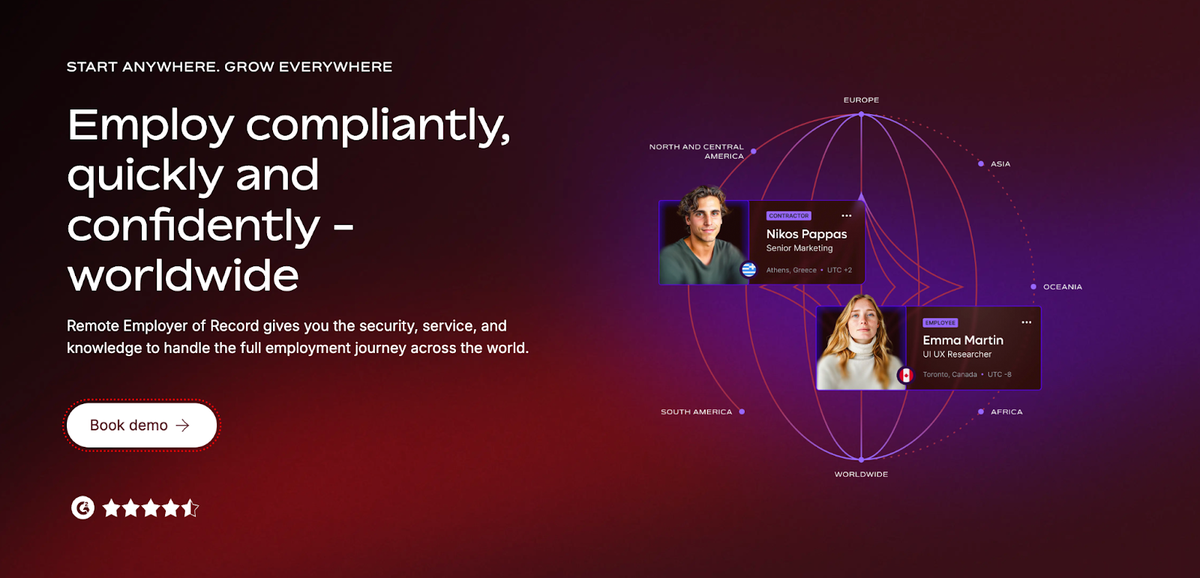
What is Remote?
Remote is a platform companies use when they hire people in different countries and want everything handled in one place. The company owns its legal entities in the countries where it operates, so it manages compliance and payroll directly instead of passing things off to partners. A lot of teams like it because the setup is simple and the pricing does not change from country to country.
Key features
- Flat EOR pricing that stays the same in all supported countries
- Contractor payments and payroll handled from the same platform
- Supports 100+ currencies for global payroll
Pros
- Clear pricing with no extra setup fees
- Free HRIS tools for basic HR needs
- Good track record with distributed teams
Cons
- Local benefits vary by country, which can increase total cost
- Support is mostly through tickets, not live chat or phone
Pricing: The EOR plan is billed at $599 per employee each month if you choose yearly billing, or $699 if you prefer to pay monthly.
Customer support: Most questions go through email or a ticket.
Best for: Teams bringing on people across several countries who prefer keeping things simple. It is often picked by companies that want clear pricing and are comfortable handling most things on their own.
5. RemoFirst – Best for cost-conscious teams that still want solid U.S. payroll support
What is RemoFirst?
RemoFirst is an Employer of Record platform often used by companies that want a simpler and more affordable way to hire internationally and in the U.S. It is usually a strong fit for smaller teams that need compliant hiring, payroll handling, and benefits administration without moving into heavier enterprise systems.
Key features
- Straightforward EOR support for U.S. hiring
- Payroll and compliance workflows handled in one platform
- Benefits administration and onboarding support for distributed teams
Pros
- More affordable than many premium EOR providers
- Simpler setup for growing teams
- Good fit for companies that want practical support without a highly complex platform
Cons
- Fewer advanced analytics and enterprise integrations
- Less suited to very large multinational teams
- May not offer the same level of customization as enterprise-focused providers
Pricing: From $199/month per employee
Customer support: Support is typically handled through chat, email, and account assistance.
Best for: Companies that want a lower-cost EOR option with reliable U.S. payroll and compliance support.
6. G-P (Globalization Partners) – Best for companies hiring across multiple U.S. states
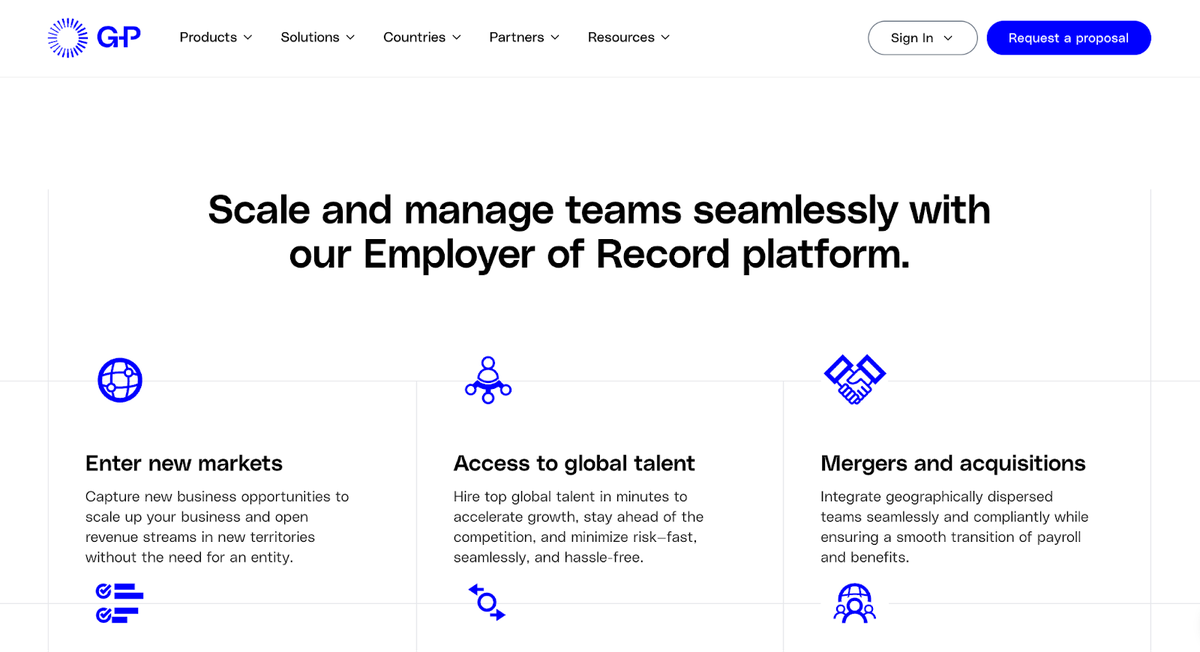
What is G-P (Globalization Partners)?
G-P (Globalization Partners) helps companies bring on workers in different countries without having to set up local entities. Bigger teams tend to use it because it offers guidance around compliance and handles a lot of the complicated parts.
Key features
- Broad country coverage
- Dedicated account managers for day-to-day questions
- Optional immigration support
Pros
- Wide global reach
- Strong compliance capabilities
- Flexible service tiers
Cons
- Pricing is not published
- Usually costs more than flat-rate EOR providers
Pricing: Pricing is custom.
Customer support: Companies usually get a dedicated contact who helps with questions, and the experience can vary based on how complex their setup is.
Best for: Larger organizations with multi-country payroll and complex rules to manage.
7. Safeguard Global – Best for companies with heavy compliance needs in the U.S. and abroad
What is Safeguard Global?
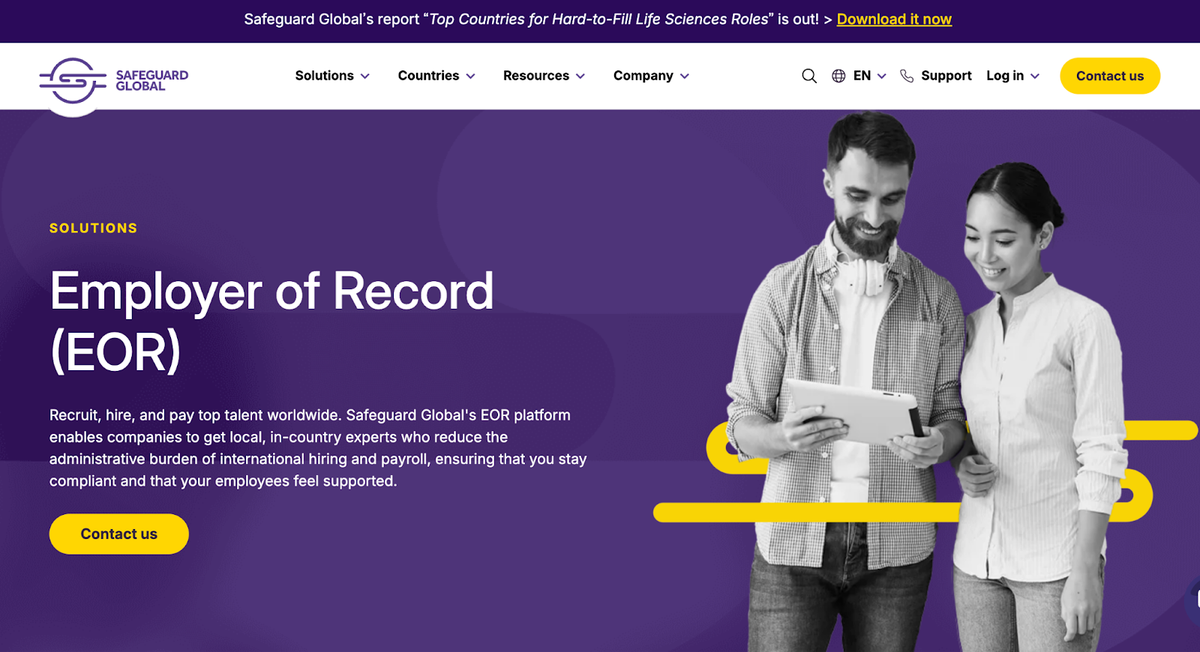
Safeguard Global is an EOR platform that companies use when they have people in several countries and want solid support around compliance. They’ve been operating since 2008 and work in more than 175 countries, including the U.S.
Key features
- Tools and reporting built for complex, multi-country teams
- Local experts who understand regional employment rules and practices
- Ability to start with EOR and later move to a full U.S. or global entity
Pros
- Strong analytics and reporting
- Deep local knowledge across many markets
- Flexible path from EOR to entity setup
Cons
- More suited to larger companies
- Implementation can take longer
Pricing: Rates are custom. Contractor support often starts somewhere around $250–$350 a month.
Customer support: Support runs through a dedicated group, with access to local expertise when needed.
Best for: Larger teams with complex hiring setups across different countries or U.S. states.
8. Rippling – Good for tech teams that want HR and IT in one place
What is Rippling?
Rippling is an HR and IT platform that helps companies manage people and devices from one system. Tech teams like it because it cuts down on switching between tools.
Key features
- HR and IT tools managed from one dashboard
- Automated onboarding, including device and app access
- Payroll for U.S. teams and global workers
Pros
- Easy to use
- Scales well as companies grow
- Works with many third-party apps
Cons
- Pricing goes up as you add modules
- Limited EOR coverage
Pricing: EOR pricing usually falls between $499 and $599 per employee monthly. HR and IT tools start at $8 per user plus a platform fee.
Customer support: Most issues go through their ticket system or email. Companies on higher plans can get a more direct support setup.
Best for: Tech-focused teams or growing companies that want HR and IT setup done in one place.
9. Oyster HR – Works well for startups hiring remote U.S. and global talent
What is Oyster HR?
Oyster HR is a service that helps smaller and growing companies hire people in the U.S. and other countries without setting up local entities. It covers more than 180 countries and gives teams access to people who understand local hiring rules, payroll, and benefits. Startups tend to choose it because it’s straightforward and offers real human guidance when they need it.
Key features
- Helps keep hiring and benefits in line with each country’s rules
- Has regional teams who answer HR or payroll questions
- Pricing options that work for smaller teams
Pros
- Quick hiring setup
- Helpful regional support
- Pricing that works for early-stage teams
Cons
- Not as automated as some tools
- May not have every feature big enterprises want
Pricing: Plans usually start around $399 a month per employee with an annual agreement.
Customer support: Most questions go to regional teams who know the local rules and can guide companies through tricky HR or compliance topics.
Best for: Startups hiring in different places that want quick onboarding and real support instead of figuring out country rules on their own.
10. Multiplier – Good for smaller companies that need to hire quickly across different U.S. states
What is Multiplier?
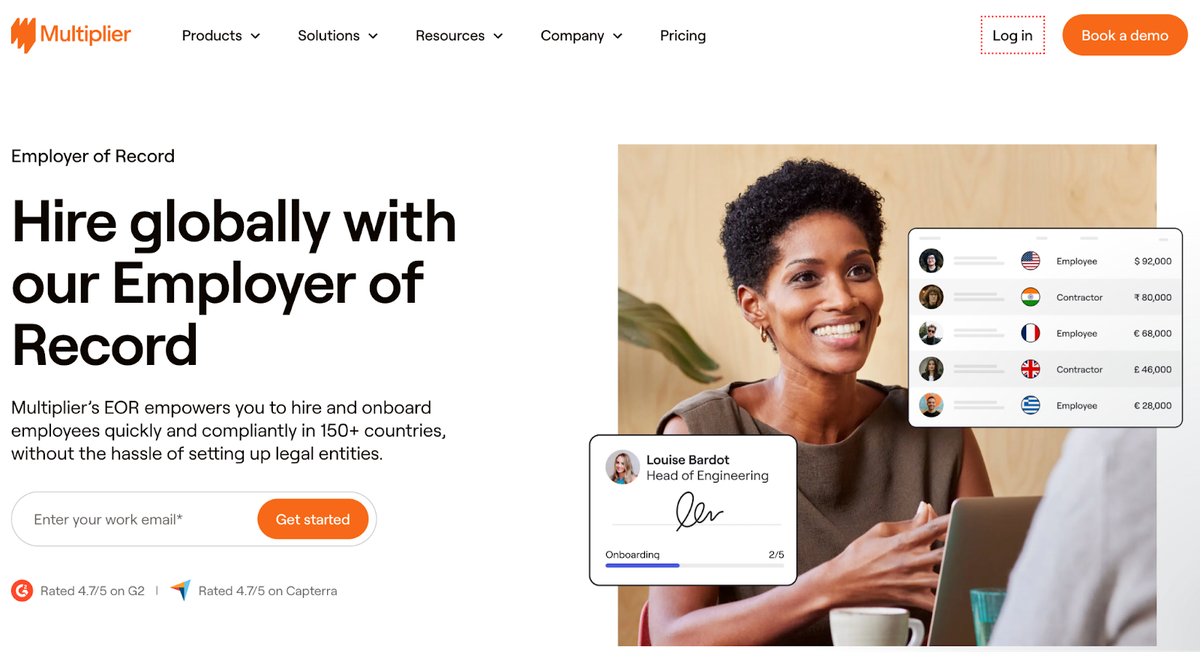
Multiplier is a service that smaller teams use when they want to hire people fast in the U.S. or overseas without dealing with a long setup. The company started in Singapore and knows the Asia-Pacific region really well, but plenty of U.S. companies use it because the pricing is easy to understand and the onboarding moves quickly.
Key features
- People can be hired and onboarded fairly quickly
- Payroll works in many currencies
- They can help handle equity and ESOP-related tasks
Pros
- Clear pricing
- Quick setup
- Useful regional knowledge
Cons
- Not as many countries covered as some competitors
- Fewer advanced analytics or integrations
Pricing: The EOR plan is usually around $400 per employee each month, and contractor pricing tends to be about $40 a month.
Customer support: Support mainly runs through email or ticket requests, and they bring in local teams when a country-specific issue appears.
Best for: Companies growing across several regions that want hiring to move fast and don’t need a long list of advanced features.
EOR vs. PEO: Understanding the difference
Companies often compare EOR and PEO services, but the main difference really comes down to who takes on the legal employer role.
With an EOR, the provider becomes the official employer for your workers. They take care of payroll, taxes, benefits, and the compliance side, while you continue managing the employee’s actual work. Since the EOR carries the legal responsibility, you can hire in new states or countries without setting up a local entity. It’s a useful option for teams hiring only a few people in different places or for companies testing a new market before committing to anything larger.
A PEO works differently. It sets up a situation where your company is still the legal employer, and the PEO steps in to help with things like payroll and benefits. Because of that, you still need your own legal entity wherever you hire. PEOs make more sense for companies focused mainly on U.S. hiring, especially when they’re planning to stay in those states long term and want help running HR, but not the full legal coverage that an EOR provides.
How EORs reduce legal and compliance risks
Hiring across different states or countries creates a lot of room for mistakes, mostly because every place has its own rules about pay, taxes, benefits, and contracts. An EOR steps in by handling the legal side of employing someone, whether they’re in another U.S. state or in a different country entirely. They take care of things like payroll taxes, required benefits, and local employment rules so companies don’t have to figure out each location on their own. This also helps avoid bigger problems, like being treated as having a legal presence in a country where you didn’t mean to set one up, or accidentally misclassifying someone as a contractor when the local laws define it differently.
EORs also help companies stay ahead of everyday problems that show up as laws shift or teams expand. They make sure contracts follow local rules, required benefits are included, and payroll runs correctly so small mistakes don’t turn into bigger issues. Because they monitor legal updates across many regions, they adjust their systems before issues become costly. They also handle privacy and data requirements that differ from one place to another, something that’s hard to keep up with on your own. For companies hiring in several states or countries, an EOR basically removes the legal and compliance load so the team can focus on running the business.
For more information on U.S. payroll, taxes and benefits, please see our Employer of Record USA guide.
Conclusion
Hiring people in different U.S. states without an EOR can be done, but it turns into a lot of extra work fast. Every state has its own rules, and keeping up with all of them is tough unless you already have a big HR setup. That’s why many companies eventually use an EOR when they start spreading out.
The “right” provider really depends on what your team needs. Some focus on price, others need more support, or coverage in certain places. Looking at a few options side by side usually makes it clear which one lines up with how you hire and where your team is heading.
FAQs
How much does an EOR service cost in the U.S.?
Most EORs charge a few hundred dollars per employee each month. Many companies see pricing fall somewhere around the mid-$300s to mid-$500s, with the exact cost depending on the provider and the state. Some states add extra required benefits, which can increase the total, but the general idea is that you’re paying a predictable monthly fee instead of managing setup, compliance, and payroll yourself.
Can I convert EOR employees to my own payroll later?
Yes. Once your company has its own entity and payroll ready, you can move the employee over. How long it takes depends on the state and any benefit changes, but many companies wrap it up in a few weeks. Most EORs explain the steps so the switch doesn’t feel confusing.
Are EOR services legal in all U.S. states?
Yes, they’re allowed everywhere in the U.S. What varies is the set of rules the provider has to follow in each state, and good EORs keep up with those requirements in the background. That matters most in states that tend to have tighter regulations, but it’s generally something an established provider already handles.
How long does it take to hire employees in the U.S. through an EOR?
Most companies see the setup take around a week or two when hiring through an EOR in the U.S. If the state has a few extra rules, it might take a little longer, but usually not by much. The whole timeline mostly depends on how fast documents are collected and approved.