


Written by

Reviewed by

Last updated:
September 9, 2026
How EOR hiring works in Mexico
An EOR is a third-party provider that can legally employ workers in Mexico, on behalf of companies without their own local entity. Whether a company wants to hire a single employee, relocate talent to Mexico for operational reasons, or hire a small team to support operations across the region, the EOR makes it possible. When you partner with an EOR provider, like Rivermate, they will do the following:
- Advise you on market-related salaries and benefits and discuss employment costs.
- Ensure that your employment contracts meet the legal requirements.
- Onboard your employee and handle compliance requirements.
- Manage global payroll, taxes, benefits and ongoing compliance on your behalf.
How an Employer of Record, like Rivermate can help with hiring and compliance in Mexico
An Employer of Record (EOR) hires on your behalf through its own local entity, so you can employ in Mexico without registering a company there. Rivermate handles the employment contract, payroll, employer contributions, statutory benefits and filings, and keeps them correct as the rules change.
_______________________________________________________________________________________________
Mexico labor market: At a glance
| The hiring market | |
|---|---|
| Greatest hiring activity: | Mexico City, Monterrey, Guadalajara and the Northern Border |
| Hiring timelines: | Local: 2-4 days |
| Foreign national: 3 - 6 months | |
| In-demand sectors: | Manufacturing, technology, support centers, logistics, professional services |
| Sectors with skills shortages: | Advanced manufacturing, artificial intelligence, data analytics, pharmaceutical and finance |
| The salary market | |
| Employer tax contributions: | 25% - 35% on top of base salary |
| Minimum wage: | MXN 315.04 a day |
| Median gross annual salary for Mexico: | MXN 96,000 |
| Income tax brackets: | From 1.92% for lower incomes to 35% for higher incomes. |
_______________________________________________________________________________________________
What will hiring cost you in Mexico?
Mexico is considered a cost-competitive employment market, particularly in comparison with the US, Canada or Europe. However, employer contributions and statutory benefits in Mexico add 25% to 35% on top of salary. Employer costs include social security contributions, payroll taxes and statutory benefits.
Base salary
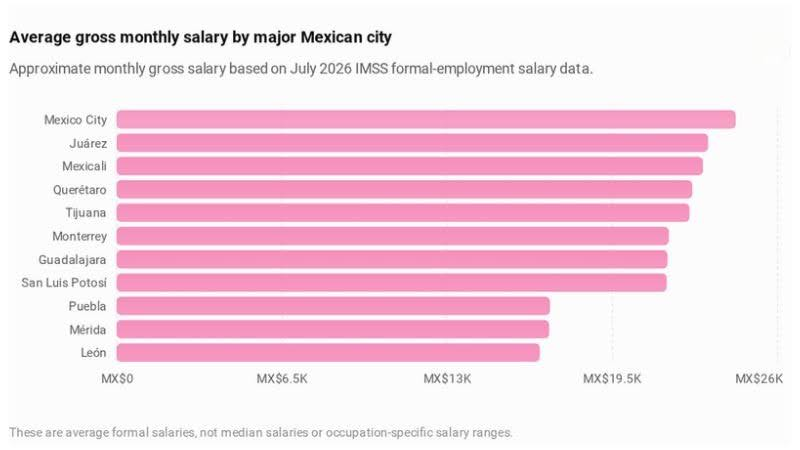
How much candidates earn in Mexico depends on the location. In Mexico City, candidates earn higher salaries than in the rest of the country, but northern industrial cities also offer strong compensation for manufacturing and engineering talent.
Current data from the Mexican Social Security Institute shows that salaries vary significantly between cities. As of 2026, the daily minimum wage is MXN 315.04 for most of the country. The rate is higher at MXN 440.87 per day in the Northern Border Free Zone.
Employer taxes and contributions
Under Mexican law, employers must pay a certain percentage towards social security and other employee benefits. These contributions are as follows:
- Social Security (IMSS): Varies (approx. 2.4–3.2% of SBC)
- Retirement Savings: 2%
- Housing Fund (INFONAVIT): 5%
- State payroll tax: 1% - 3%
- Work Risk Premium: Varies
Statutory benefits
Beyond the base salary, Mexico’s wage structure includes several important elements that employers must be aware of:
- Christmas bonus (Aguinaldo): This must equal 15 days' wages and must be paid by December 20th each year.
- Profit Sharing (PTU): You must share 10% of your company's renta gravable (taxable income as determined under the Income Tax Law, not simply "pre-tax profits").
- Vacation Premium: A bonus of at least 25% of the pay they would normally receive for those vacation days.
- Overtime Pay: 200% of the normal hourly rate for the first nine hours of overtime in a week. After nine hours, employees receive 300% of their standard rate.
- Annual Leave: Employees receive 12 days of paid vacation in the first year. This increases by two days for each year of service, up to 20 days. After the sixth year, they earn an additional two days for every five years of service.
- Maternity Leave: Mothers receive 12 weeks of paid maternity leave, split into six weeks before and six weeks after childbirth. The Mexican Social Security Institute (IMSS) covers the pay during this time
_______________________________________________________________________________________________
Calculate employment costs in Mexico
Calculate Employment Costs
Employment Cost Breakdown
Select a country and enter a salary to see the employment cost breakdown
_______________________________________________________________________________________________
What to expect when hiring in Mexico
Overall: 🟡 Moderately challenging
| Easier to navigate | More challenging to navigate |
|---|---|
| 🟢 Overall talent availability | 🔴 Highly regulated employment law |
| 🟢 Talent in major employment centers | 🔴 Regional salary differences |
| 🟡 Competitive salary levels | 🔴 Availability of specialist talent |
| 🟡 English-speaking talent in major hubs | 🔴 Immigration for foreign nationals |
Mexico is an attractive option, particularly for the USA and Canada, because it has a large local talent pool and expats who work in major centers. Its proximity to the USA means that many businesses already operate across the border and business practices can feel relatively familiar to a foreign company.
Beyond this, Mexico has its own employment culture, and the realities of hiring in Mexico can be very different to what employers in the US, Canada or Europe are used to. For instance, employees in Mexico are used to a Christmas bonus, vacation pay, and profit-sharing, while this is not common in North America.
Overall talent availability in Mexico is good for lower-income jobs, but the more specialized skills can be difficult to find. This affects hiring timelines, and where immigration is involved, the timelines can be slower than most employers would like.
_______________________________________________________________________________________________
Hiring local vs. foreign employees in Mexico
When hiring through our EOR services, one of the first questions you’ll be asked is whether you are hiring a local or a foreign national. This matters because each situation requires a different approach in Mexico.
Local hires in Mexico
Hiring a local is straightforward, and onboarding can be done within a few days. For remote or hybrid workers, the process is simple, as long as the employee does not work permanently on-site at a company. If an employee will work on-site, additional REPSE considerations may apply, and the EOR provider will need to conduct an additional review. Our Rivermate expert in Mexico can help you understand when and how this legislation will affect hiring there.
Foreign hires in Mexico
Employing foreign talent requires additional immigration steps and work authorization.
This increases the hiring timeline depending on whether:
- The employee holds dual Mexican nationality.
- The employee has an existing residency card.
- A new immigration application is required.
The average hiring timeline for foreign nationals in Mexico is 3 months, but can take up to 6 months if there are complications. Challenges include missing documentation, delayed background checks, and missed interviews. Timelines can also be location-dependent. In Mexico City, the process generally moves faster than in most other areas.
If an employee has permanent or temporary residency, the EOR expert will review the case to determine whether additional requirements apply. In Mexico, an employer cannot hire an employee until it receives the necessary authorizations.
In Mexico, strict quotas limit how many foreign nationals a company can employ. Only 10% of the workforce may be expats. A foreign national with a permanent residency card is not automatically counted toward the quota, and employers must still justify hiring a foreigner instead of a local worker. The 10% quota for specialized roles is calculated per speciality rather than the total workforce.
_______________________________________________________________________________________________
How an Employer of Record, like Rivermate can help with work permits in Mexico
Navigating work permits can be complex and time‑sensitive. Rivermate coordinates the entire process end‑to‑end: determining the right visa category, preparing employer and employee documentation, liaising with local authorities, and ensuring full compliance with country‑specific rules. Our in‑country experts accelerate timelines, minimize refusals, and keep you updated on each milestone so your hire can start on time—legally and confidently.
_______________________________________________________________________________________________
Staying compliant when hiring in Mexico
Mexican authorities require all employers to manage compliance risks by complying with local labor laws. For foreign employers, three key areas deserve particular attention because they significantly impact the employment relationship and employer obligations.
Fixed-term contracts vs indefinite contracts
Under federal labor law in Mexico, legal employers may use both fixed-term contracts and indefinite-term contracts. While fixed-term workers receive the same statutory benefits as permanent workers, the probation period and severance pay may apply differently.
Indefinite contracts are the most common type of employment agreements in Mexico and are encouraged by the government. Use of a fixed-term contract depends on the job the employee will do and whether those activities can be completed in a set period. If an employee continues to work after the contract expires and no new contract is drawn up, then they automatically become a permanent employee.
Employment agreements must comply with Mexican labor laws. These laws provide strong worker protections, and authorities expect employers to adhere to them.
Probation periods in Mexico
Probation periods apply to both fixed-term and indefinite contracts. For fixed-term contracts, it applies only if the duration is longer than 180 days. Probation periods in Mexico are as follows:
- Standard workers: 30 days
- Specialized technical, managerial or executive roles: Maximum 180 days (3 months)
These probation periods must be explicitly stated in the employment contract, and for most workers, they cannot be extended. An exception applies to senior executive positions, where probationary periods can be up to six months.
Terminations
Terminating an employee in Mexico requires careful attention to employment laws. Employers can terminate an employee only for legally recognized causes. An unjustified termination can expose you to significant compensation obligations. Final payments can include accrued salary, vacation, and bonus payments. For employers using EOR services, it is important to have the EOR manage the termination process and calculate the correct statutory entitlements to reduce the risk of non-compliance.
_______________________________________________________________________________________________
How an Employer of Record can help you hire in Mexico
Finding the right candidate in Mexico is only the first step. Once you’ve found them, you still need to hire them. To do this, you either need to establish your own legal entity or work with a third-party provider, like an EOR provider. Establishing your own entity in Mexico for a single employee, one who wants to relocate, or a small team might work, but it still leaves you managing complex compliance matters.
This is when partnering with an EOR, like Rivermate, can significantly benefit your business. We hire your employees through our existing infrastructure and expertise. As the legal employer, we will manage all compliance, from onboarding through termination. We will also handle the global payroll, taxes and statutory benefits.
For you, as the foreign employer, this can change what hiring in Mexico looks like. You can hire compliantly without a legal entity, onboard people faster, and scale as needed.
You can focus on your business, knowing that your employee or team is being taken care of locally.
_______________________________________________________________________________________________
Ready to hire in Mexico?
Rivermate can handle compliant contracts, payroll, benefits and ongoing HR support.
Employ top talent in Mexico through our Employer of Record service
Book a call with our EOR experts to learn more about how we can help you in Mexico







Book a call with our EOR experts to learn more about how we can help you in Mexico.
Trusted by more than 1300 companies around the globe


_______________________________________________________________________________________________
Frequently asked questions about EOR in Mexico
_______________________________________________________________________________________________
Sources:
Written by

Karl van der Weert
Karl leads the Customer Success team at Rivermate, overseeing all existing client relationships with a focus on delivering a smooth and highly personal EOR experience. Over the past two years, he has managed onboarding, payroll, and ongoing support, working closely with clients to resolve issues quickly and transparently. He coordinates with internal teams and local partners to ensure compliant, efficient EOR solutions, while identifying opportunities to support client growth. His role combines hands-on problem solving with strategic account management, with the goal of building strong, long-term client partnerships.
View profileReviewed by

Sebastien Wakim
Sébastien Wakim is CEO of Rivermate and has led the Hightekers group since 2024. An early Uber employee, he launched and scaled the company's operations across multiple MENA markets before holding senior leadership roles at OLX Group. He later co-founded Wisewell, a water-technology venture active in the US and GCC. He holds an MBA from Columbia Business School and an MS in engineering from UC Berkeley.
View profile